
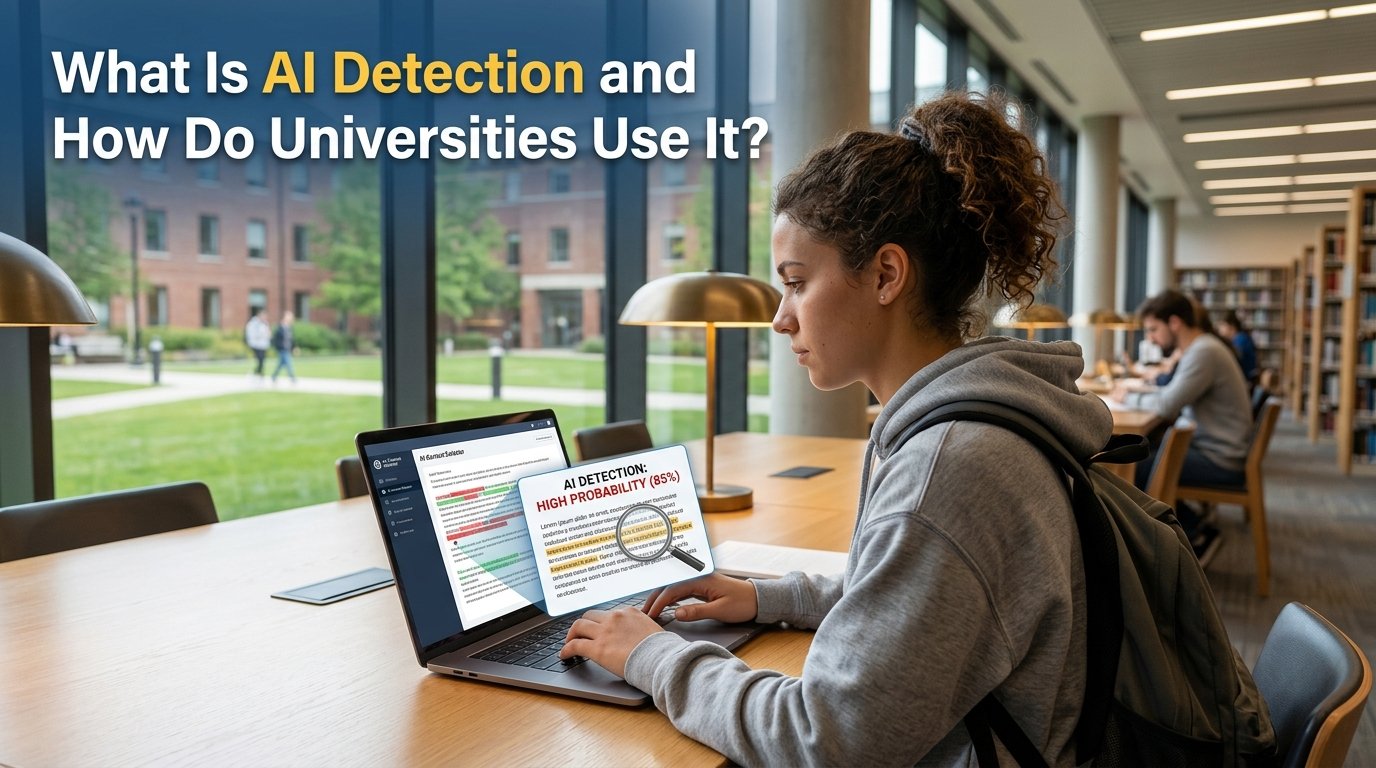
Most students have a rough, slightly wrong idea of how AI detection works. The common assumption is that these tools somehow check a submission against a known database of ChatGPT outputs, matching text the way a plagiarism checker matches against existing sources. That is not what is happening. AI detectors do not look for a match. They look for a pattern, specifically, statistical patterns in how predictable and uniform the writing is, and predictability turns out to be a genuinely imperfect proxy for authorship.
This matters because misunderstanding how detection works leads to two opposite mistakes: overconfidence in it (assuming a low score proves nothing was AI-assisted) and unwarranted panic (assuming a flagged score proves guilt). Neither is accurate. This post explains what these tools actually measure, how Turnitin’s AI detection specifically works, why false positives happen, what UAE universities are doing with the technology, and what to do if your own genuine work gets flagged.
| Academic Integrity Notice
This article explains how AI detection technology works for informational purposes. It is not guidance on evading detection or submitting AI-generated work as your own where your institution prohibits this. Academic integrity policies vary by UAE institution; always follow your specific university’s rules. |
What AI Detection Tools Actually Measure
AI detection tools do not read text the way a human marker does. They analyse statistical properties of the writing and produce a probability score based on how closely those properties resemble known patterns in AI-generated text. Two properties matter most.
Perplexity
Perplexity measures how predictable a piece of text is to a language model. Large language models generate text by repeatedly choosing the statistically most likely next word given everything written so far. This tends to produce text that is, on average, more predictable, lower perplexity, than typical human writing, which includes more unexpected word choices, tangents, and stylistic quirks. A detector estimates how surprised a language model would be by your specific word choices; consistently low surprise suggests AI generation.
Burstiness
Burstiness measures variation in sentence length and structure across a passage. Human writing tends to be “bursty,” mixing short punchy sentences with longer, more complex ones in an irregular pattern. AI-generated text, especially from earlier or less sophisticated prompting, tends toward more uniform sentence length and rhythm. Low burstiness (consistent, evenly-paced sentences throughout) is one of the stronger signals detectors weight.
A Worked Example: The Same Idea, Two Ways
Seeing the difference directly is more useful than describing it abstractly. Below is the same basic point, written twice: once in a way that mimics typical AI output patterns, once in a way that mimics typical human variation.
| Version A (higher perplexity/burstiness pattern):
Remote work sounds great until your internet cuts out mid-presentation. I have strong feelings about this because it happened to me twice last month. Productivity gains? Sure, on paper. But nobody talks about the 40 minutes I lost troubleshooting a router while my manager waited on a call. |
| Version B (lower perplexity/burstiness pattern):
Remote work has been shown to increase productivity in many organisational contexts. Employees report higher levels of satisfaction when given flexibility in their working arrangements. However, remote work also presents certain challenges that organisations must consider. These challenges include communication difficulties and reduced team cohesion. |
Version A varies sentence length dramatically, includes a specific personal anecdote, and uses informal, slightly unpredictable phrasing (“sounds great until your internet cuts out”). Version B uses consistently medium-length sentences, a uniform formal register throughout, and generic claims with no specific grounding. Neither version is inherently better writing, but Version B’s statistical uniformity is the kind of pattern that pushes a detector’s score upward, regardless of who or what actually wrote it.
How Turnitin’s AI Detection Specifically Works
Turnitin, the tool most UAE universities license, uses a classifier trained to distinguish AI-generated text from human-written text at the sentence level, then aggregates sentence-level predictions into an overall document score. Turnitin has published information describing its detector as trained primarily on GPT-family model outputs alongside human-written comparison text, and the company has stated its own internal testing shows a low false positive rate on purely human-written text, though independent researchers and educators have reported higher real-world false positive rates than vendor-reported figures, particularly on certain kinds of writing discussed in the next section.
The practical output most students see is a percentage score representing the proportion of the submission the model estimates as AI-generated, often accompanied by sentence-level highlighting showing which specific passages contributed most to that score. This sentence-level breakdown is genuinely useful information, since it shows you exactly which parts of your writing triggered the flag, rather than leaving you to guess.
What UAE Universities Are Doing With This Technology
UAE institutions are still in a relatively early, actively evolving phase of setting formal AI detection policy, and practices vary meaningfully between universities. Some general patterns are visible across the sector.
- Most UAE universities that have adopted Turnitin’s AI detection use it as one input into an academic integrity review process, not as automatic, final proof of misconduct on its own.
- Threshold percentages that trigger a formal review vary by institution and are frequently set at the department or module level rather than as a single fixed university-wide number.
- Many UAE institutions are simultaneously developing explicit policies on acceptable AI use for coursework, distinguishing between AI as a prohibited ghostwriting tool and AI as a permitted research or brainstorming aid, a distinction that is still being worked out differently across departments.
| A note on specifics: Exact thresholds and policies differ by institution and are subject to change. Always check your own university’s current, official academic integrity and AI use policy directly rather than relying on general figures. |
Why AI Detection Is Not 100% Accurate
The perplexity and burstiness signals detectors rely on are correlated with AI generation, not proof of it. Several categories of genuinely human writing share statistical properties with AI output, which is why false positives are a real, documented limitation rather than a rare edge case.
| Writing type | Why it can trigger false positives |
| Non-native English writing | Often more formulaic and grammatically regular than native speaker writing, since it draws on learned patterns rather than intuitive variation. |
| Highly formal academic or technical writing | Academic convention favours consistent register and structured sentences, naturally lowering burstiness regardless of authorship. |
| Writing on well-established, textbook topics | Common, widely-taught explanations of standard concepts tend to converge on similar, predictable phrasing across many writers. |
| Heavily edited or proofread writing | Editing for clarity and consistency can inadvertently smooth out the natural irregularity that signals human authorship to a detector. |
This is not a reason to dismiss AI detection entirely, it remains a useful signal when interpreted carefully. It is a reason universities and students alike should treat a flagged score as the start of a conversation, not the end of one.
What to Do If Your Genuine Work Gets Flagged
If you wrote your own submission and it has been flagged, a calm, structured response works better than panic.
- Request the specific sentence-level breakdown if it was not automatically provided, so you understand exactly which passages triggered the flag rather than reacting to the headline percentage alone.
- If you have a revision history, drafts, notes, or research materials showing your own development of the work, these can be genuinely useful evidence of authorship in an academic integrity conversation.
- Engage with your institution’s formal process directly and honestly rather than avoiding it. Academic integrity panels generally distinguish between a student engaging constructively with a concern and one who appears evasive.
- If the flagged sections reflect a genuine stylistic pattern (very formal writing, textbook explanations, certain phrasing habits), understanding why can help you communicate this clearly, and can inform how you write going forward if you want to reduce the likelihood of future false positives.
Using AI Responsibly in Coursework
Separate from the false-positive issue, a growing number of UAE institutions now permit some forms of AI assistance, research, brainstorming, or checking, while still requiring the final submission to reflect the student’s own understanding and writing. Where this applies, the practical distinction that tends to matter is between using AI to develop your own thinking versus using AI to produce your final submitted text wholesale.
Concretely, this generally means: using AI to explore a topic, generate discussion questions, or organise your own notes is commonly permitted under an “AI as aid” policy. Pasting an AI-generated paragraph directly into your submission as your own writing generally is not, under that same policy, even if the underlying ideas originated from your own prompting. The safest approach, given how much policy varies between UAE institutions and even between departments at the same institution, is to check your specific module’s written guidance rather than assume a general rule applies.
If You Need Support With a Flagged Submission
If your genuinely original work has been flagged and you want a human review of what may be causing it, or if you are working under an AI-as-aid policy and want help developing your own notes into a properly written submission, our AI Content Review service provides exactly this kind of support, reviewed by a human editor, never processed through automated bypass tools.