

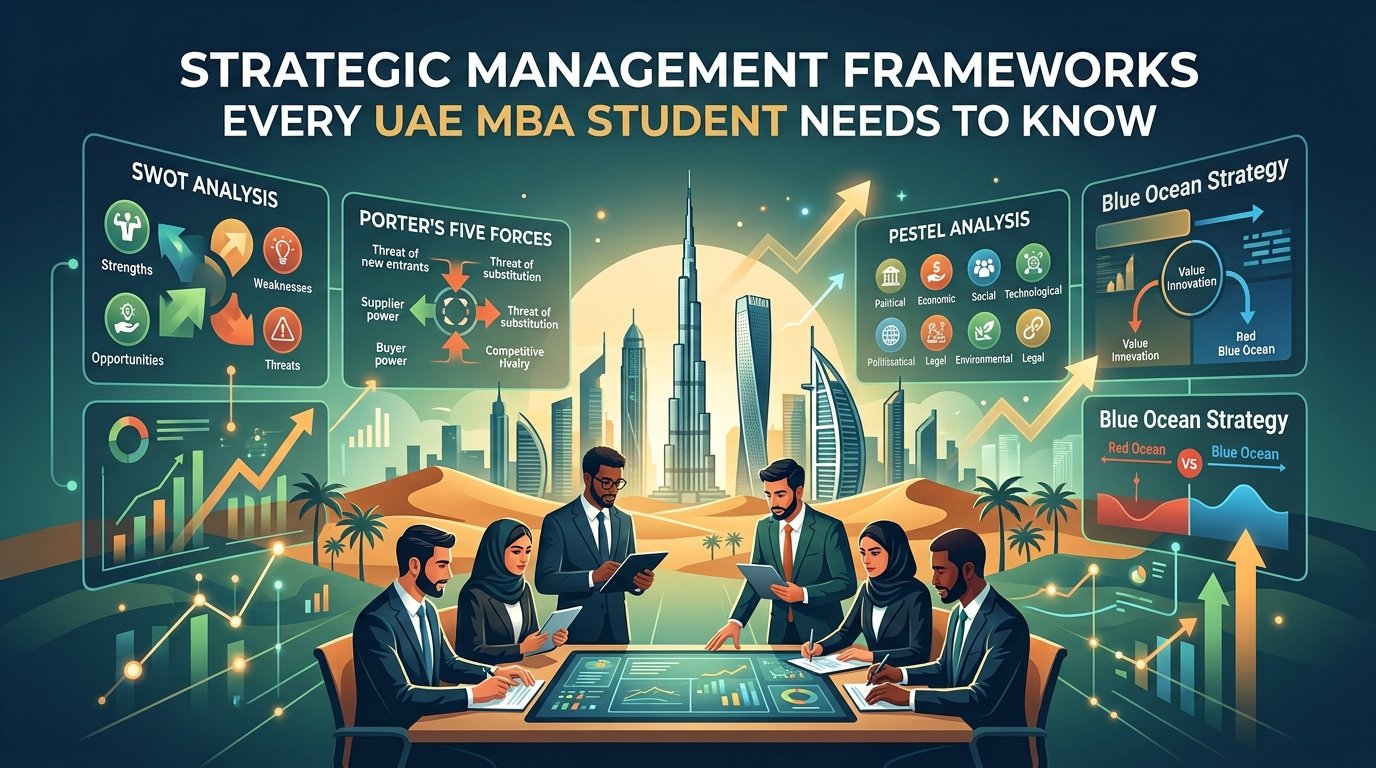
Every MBA student learns the same five or six strategic management frameworks within the first term. Porter’s Five Forces, PESTLE, SWOT, Blue Ocean Strategy, the Balanced Scorecard, all covered, all examined, all reused constantly across assignments for the rest of the programme. What rarely gets taught explicitly is the difference between naming a framework and actually applying it, which is precisely the gap between a pass mark and a distinction on almost every strategic management assignment.
This guide goes through the five frameworks that show up most often in UAE MBA coursework, what each one is genuinely useful for, how to apply it to a real regional company rather than a generic hypothetical, and the specific mistake students make with each one that quietly caps their mark.
Why Frameworks Matter, and Why Naming Them Is Not Enough
A strategic management assignment is not really testing whether you know what Porter’s Five Forces is. Every student in the cohort knows what it is. It is testing whether you can use it as an analytical tool, meaning applying it to a specific organisation, weighting the different elements against each other, and drawing a conclusion the framework alone does not hand you automatically.
The single most common mark-losing pattern across every framework covered in this guide is the same: listing the framework’s components against a company with no weighting, no synthesis, and no resulting insight. A SWOT that lists four strengths, four weaknesses, four opportunities, and four threats with no connection between them is description. A SWOT that identifies which strength could be used to capture which specific opportunity is analysis. That distinction is what this guide focuses on for each framework below, with a worked example for each using a real Middle East based company.
| A note on the worked examples below: These examples use publicly known aspects of each company’s business model and strategic direction to demonstrate how each framework is applied, not confidential or invented internal data. For an actual assignment, always verify current facts and figures against the company’s own annual report, investor relations materials, or other primary sources rather than relying on any secondary summary, including this one. |
Porter’s Five Forces
Porter’s framework analyses industry attractiveness through five competitive forces: rivalry among existing competitors, the threat of new entrants, the bargaining power of suppliers, the bargaining power of buyers, and the threat of substitute products or services.
Applying it to a UAE context
The UAE aviation sector offers a genuinely interesting Five Forces case, because it combines characteristics that pull in different directions. Full-service carriers based in the UAE compete in a market with substantial rivalry from other Gulf and international full-service airlines, but face relatively high barriers to new entry given the capital intensity of establishing a competing full-service carrier, and moderate substitute threat from low-cost regional carriers on shorter routes. A strong assignment does not just note these five points, it explains which force is actually the dominant strategic pressure for a given company at a given time, and why that force matters more than the other four in this specific case.
| Common mistake:
Listing all five forces with roughly equal weight and no argument about which one is actually driving competitive dynamics in this specific industry right now. A distinction-level answer identifies the one or two forces doing most of the analytical work and explains why the others are comparatively less significant for this case. |
| Worked example: Emirates (Dubai)
Emirates operates a full-service, hub-and-spoke model built around Dubai International Airport’s geographic position between Europe, Asia, and Africa. Applying Porter here, the dominant force is arguably rivalry among established full-service carriers (other major Gulf and international long-haul airlines competing on the same connecting-traffic model), rather than new entrant threat, since building a comparable long-haul hub carrier requires capital and route-rights access few new competitors can assemble quickly. A strong assignment would argue this point explicitly, rather than treating all five forces as equally significant, and would support it with Emirates’ publicly stated fleet and route strategy from its own annual report. |
| Force | What it means | Pressure on Emirates |
| Rivalry among competitors | Competition from other established players in the same industry. | High |
| Threat of new entrants | How easily new competitors can enter the market. | Low |
| Bargaining power of suppliers | How much influence suppliers (aircraft manufacturers, fuel) have over terms. | Medium |
| Bargaining power of buyers | How much influence customers have over price and service terms. | Medium |
| Threat of substitutes | Alternative ways customers could meet the same need. | Low |
PESTLE Analysis
PESTLE examines Political, Economic, Social, Technological, Legal, and Environmental factors shaping an organisation’s external environment. It is one of the most frequently assigned frameworks and also one of the most frequently done badly, usually because students treat it as a factual checklist rather than a strategic tool.
UAE-specific factors that generic PESTLE templates miss
- Emiratisation policy and its direct workforce planning implications for private sector employers, a factor almost entirely absent from Western PESTLE templates but highly material to UAE-based organisational strategy.
- The 2023 introduction of UAE corporate tax and its effect on financial planning and investment decisions across sectors previously operating in a zero corporate tax environment.
- Free zone versus mainland regulatory distinctions, which materially affect market entry strategy for any organisation considering UAE expansion.
- Vision 2031 and related national economic diversification targets, which shape sector-level opportunity in areas like renewable energy, technology, and tourism.
| Common mistake:
Treating each PESTLE letter as a standalone list of facts rather than connecting factors back to a specific strategic implication. Naming UAE corporate tax as an Economic factor without explaining what it actually means for the specific organisation’s strategy is description, not analysis. |
| Worked example: ADNOC (Abu Dhabi)
For a state-linked energy company such as ADNOC, the Political and Environmental letters carry disproportionate strategic weight compared to a typical PESTLE application. Politically, ADNOC’s strategy is directly shaped by UAE national energy policy and OPEC+ production coordination, not just general market conditions. Environmentally, ADNOC has publicly committed to net-zero targets and lower-carbon investment as part of the UAE’s broader energy transition positioning. A strong PESTLE analysis of ADNOC would explain how these two factors interact, national energy strategy pushing toward continued production capacity while environmental commitments push toward diversification into lower-carbon energy, rather than listing them as separate, unconnected points. |
| Factor | UAE / Regional Example | Relevance to ADNOC |
| Political | UAE national energy policy, OPEC+ coordination | Very High |
| Economic | Global oil price volatility, UAE economic diversification | High |
| Social | Rising regional demand for cleaner energy sources | Medium |
| Technological | Carbon capture, renewable energy investment | High |
| Legal | UAE corporate tax (2023), international climate agreements | Medium |
| Environmental | Net-zero 2050 commitments, emissions regulation | Very High |
SWOT Analysis
SWOT is the framework most students learn first and, partly because of that familiarity, the one most often done at a superficial level in postgraduate work. The four-box grid is not the analysis. The analysis is what happens when you connect the boxes to each other.
Moving beyond the four-box grid: the TOWS matrix
The TOWS matrix takes the same SWOT inputs and forces explicit pairing: which strengths could be used to capture which opportunities (SO strategies), which weaknesses expose the organisation to which threats (WT strategies), and so on across all four combinations. This single step, pairing internal and external factors rather than listing them separately, is usually the difference between a SWOT that reads as a distinction-level analysis and one that reads as a completed template.
| Common mistake:
Producing a complete four-box SWOT grid and treating that as the finished analysis. The grid is the input. The strategic options generated by systematically pairing internal and external factors are the actual analytical output markers are looking for. |
| Worked example: Majid Al Futtaim (UAE)
Majid Al Futtaim, the diversified UAE retail, shopping mall, and leisure operator, offers a useful TOWS pairing exercise. A strength (an established network of large-format malls and anchor retail relationships across the GCC) can be paired with an opportunity (growing regional demand for integrated retail-leisure-entertainment destinations) to generate an SO strategy: expanding experiential and entertainment offerings within existing mall assets rather than pursuing new standalone developments. A weakness (high fixed-cost exposure to physical retail space) paired with a threat (continued e-commerce growth) generates a WT strategy: the kind of omnichannel integration many mall operators in the region have pursued. The pairing itself, not the four lists, is what produces this level of insight. |
| STRENGTHS
Established malls, anchor retail relationships, strong GCC footprint, integrated leisure and entertainment offering. |
WEAKNESSES
High fixed-cost exposure to physical retail space, geographic concentration in GCC limiting diversification. |
| OPPORTUNITIES
Growing regional demand for integrated retail-leisure-entertainment destinations, tourism sector growth across the UAE. |
THREATS
Continued e-commerce growth, changing consumer footfall patterns post-pandemic. |
| Pairing | Strategic option generated |
| SO (Strength + Opportunity) | Expand experiential and entertainment offerings within existing mall assets, leveraging established retail relationships to meet rising demand for integrated leisure destinations. |
| WT (Weakness + Threat) | Pursue omnichannel integration to offset fixed physical retail cost exposure against continued e-commerce growth. |
Blue Ocean Strategy: When to Use It Instead of Porter
Blue Ocean Strategy, developed by Kim and Mauborgne, argues that sustainable competitive advantage comes from creating uncontested market space rather than competing head-to-head within an existing industry structure. This makes it a fundamentally different tool from Porter’s Five Forces, which assumes competition within a defined industry as the starting point.
Choosing between Porter and Blue Ocean
Use Porter’s Five Forces when your assignment asks you to analyse competitive positioning within an existing, clearly defined industry. Use Blue Ocean Strategy when the organisation you are analysing has deliberately avoided direct competition by creating a new market category, or when your assignment specifically asks you to evaluate differentiation strategy rather than competitive positioning. Applying Blue Ocean to a company that is straightforwardly competing within an established industry structure, without evidence of genuine market-creating behaviour, usually produces a forced analysis that does not fit the framework’s actual purpose.
| Common mistake:
Using Blue Ocean Strategy as a synonym for “differentiation” without applying the framework’s specific Four Actions structure: which factors the company has eliminated, reduced, raised, or created relative to industry norms. Without walking through these four actions explicitly, the analysis is using Blue Ocean language without actually using the Blue Ocean method. |
| Worked example: Careem (regional, headquartered in Dubai)
Careem’s early positioning in MENA ride-hailing is a reasonable regional Blue Ocean case, though a strong assignment should test the framework rather than simply assert it applies. Walking through the Four Actions: Careem reduced the friction of cash-dependent, informal taxi booking common across the region at the time; raised trust and safety through driver verification and in-app tracking; created new value through hyperlocal features such as local language support and region-specific payment methods; and eliminated the need for dedicated taxi-hailing infrastructure by building on smartphone penetration. Note that a full Blue Ocean analysis should also address whether this uncontested space remained uncontested as competitors entered, since Blue Ocean strategies frequently attract fast followers once proven. |
| ELIMINATE
Cash-dependent, informal taxi booking common in the region at the time. |
REDUCE
Friction in the booking process; reliance on street hailing or phone dispatch. |
| RAISE
Trust and safety, through driver verification and in-app trip tracking. |
CREATE
Hyperlocal features: local language support, region-specific payment methods. |
The Balanced Scorecard in a UAE Corporate Context
The Balanced Scorecard, developed by Kaplan and Norton, translates strategy into measurable objectives across four perspectives: financial, customer, internal business processes, and learning and growth. It appears less often than the frameworks above in undergraduate work but shows up regularly in MBA strategic management and performance management modules.
For UAE-based organisational analysis, the Balanced Scorecard is particularly useful when an assignment asks you to move beyond diagnosis (what is the strategic situation) toward implementation (how would strategy actually be executed and measured). A strong Balanced Scorecard analysis for a UAE case organisation typically needs to address how each perspective interacts with local context: customer perspective metrics that account for the price-sensitivity and service-expectation differences across UAE’s diverse customer base, and learning and growth metrics that reflect the workforce planning realities of Emiratisation targets alongside a large expatriate professional workforce.
| Common mistake:
Populating all four perspectives with generic metrics (revenue growth, customer satisfaction, process efficiency, employee training) without explaining how these specific metrics connect to the specific strategy the assignment is meant to be evaluating. The Balanced Scorecard should measure a stated strategy, not exist as a generic four-box performance template. |
| Worked example: Emirates NBD (Dubai)
For a UAE banking group such as Emirates NBD, a Balanced Scorecard built around a stated digital banking strategy might look like this. Financial: growth in digital transaction volume as a share of total transactions, not just overall revenue. Customer: digital channel adoption and satisfaction scores specifically among retail customers, since digital strategy affects retail and corporate banking differently. Internal processes: reduction in manual processing time for digitally-initiated transactions. Learning and growth: staff digital skills training completion linked specifically to the roles most affected by the digital shift, such as branch staff transitioning toward advisory functions. Each metric ties back to the same stated strategy rather than existing as a generic banking KPI. |
| Perspective | Example metric (digital banking strategy) |
| Financial | Growth in digital transaction volume as a share of total transactions, not just overall revenue. |
| Customer | Digital channel adoption and satisfaction scores specifically among retail customers. |
| Internal Processes | Reduction in manual processing time for digitally-initiated transactions. |
| Learning & Growth | Staff digital skills training completion, linked to roles most affected by the digital shift. |
A Quick Reference: Which Framework for Which Question
- Porter’s Five Forces: the assignment asks you to assess industry attractiveness or competitive intensity within a defined market.
- PESTLE: the assignment asks you to analyse the external macro-environment shaping strategic options.
- SWOT / TOWS: the assignment asks for an internal-external combined assessment leading to strategic recommendations.
- Blue Ocean: the assignment asks about differentiation, market creation, or escaping direct competition.
- Balanced Scorecard: the assignment asks how a strategy would actually be implemented and measured, not just diagnosed.
Need Help Applying These Frameworks to Your Assignment?
Our strategic management writers hold MBA and postgraduate qualifications and apply these frameworks the way markers actually assess them, grounded in specific organisations, not generic templates.