

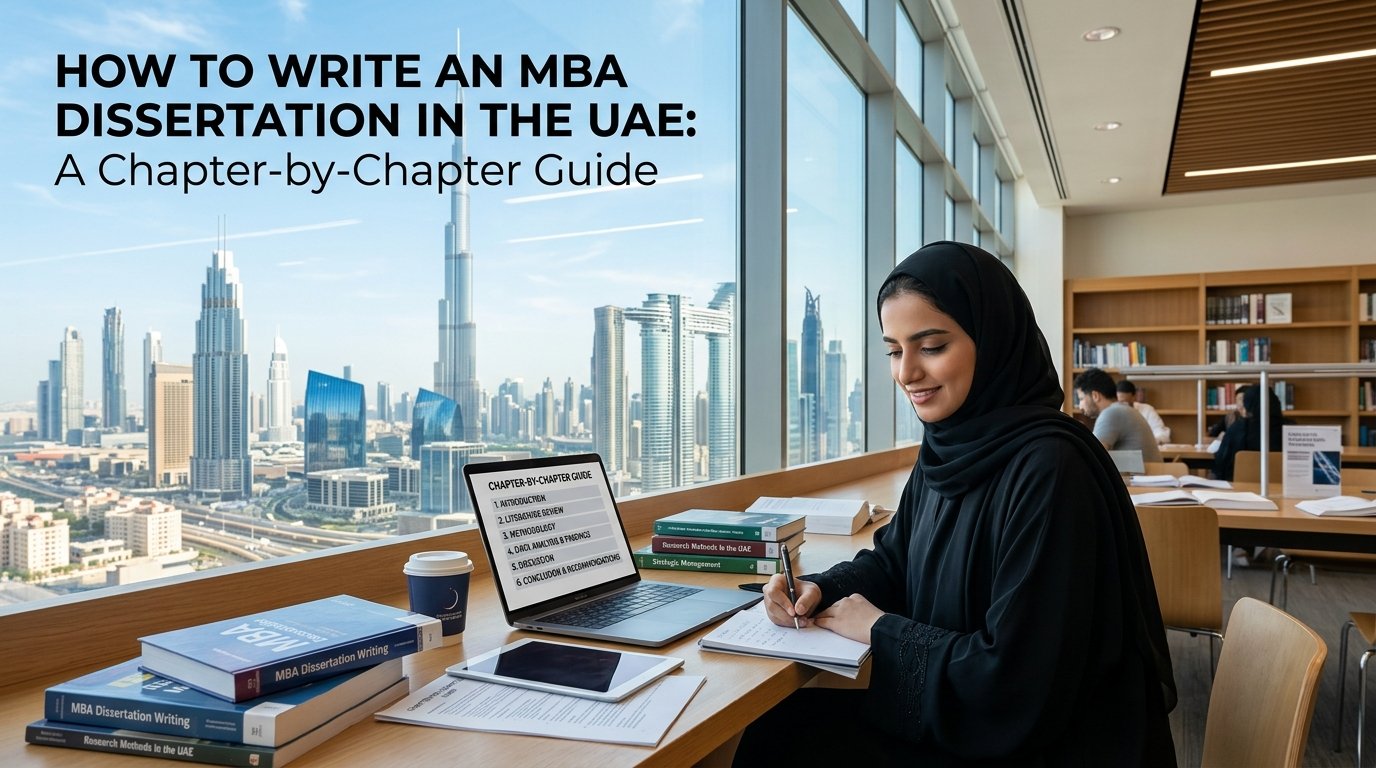
The MBA dissertation is different from anything else in the programme. Every taught module up to that point has a syllabus, a reading list, and a marker who tells you roughly what a good answer looks like. The dissertation has none of that. You choose the topic, you design the study, and the first time anyone gives you real feedback on the whole thing is often after you have already written most of it.
That structural difference is why so many otherwise strong MBA students find the dissertation the hardest part of the programme, not because the individual skills are new, but because nobody has asked them to combine research design, extended argument, and independent judgement into one 15,000 to 20,000 word document before. This guide walks through what examiners are actually looking for, how to choose a topic that works in a UAE or GCC business context, and a chapter-by-chapter breakdown of what each section needs to do.
What Examiners Actually Look For
Before getting into structure, it helps to understand what a dissertation is being assessed against, because it is different from what a taught-module assignment is assessed against.
- A clear, answerable research question, not a topic area. “Employee engagement in UAE hospitality” is a topic. “How does leadership style influence employee engagement in four and five star Dubai hotels” is a research question.
- Evidence of independent critical thinking, not just competent summary of what other people have found.
- A methodology that is justified, not merely described, meaning you explain why your chosen approach was the right one for this specific question, not just what you did.
- An honest discussion of limitations. Examiners are more reassured by a candidate who understands the boundaries of their own study than by one who claims unrealistic generalisability.
- A genuine, even if modest, original contribution: a new context for an existing theory, a comparison nobody has run before, or new primary data on a question others have only discussed theoretically.
Choosing a Topic That Works in a UAE or GCC Context
Topic selection is where a large share of dissertation problems begin, often months before the actual writing starts. A few principles that consistently produce workable topics for UAE-based MBA students:
Ground it in accessible data
A topic that requires data you cannot realistically obtain, whether that is access to a specific company’s financials, a large primary survey sample, or interviews with executives who will not respond to a student researcher, becomes a problem six weeks before submission rather than at the start. Choose a topic where your data sources, whether primary or secondary, are realistically accessible from where you are.
Use the UAE and GCC context as a strength, not an afterthought
UAE and GCC business schools, including UAEU, HCT, and Zayed University, generally welcome dissertations that apply established Western management theory to a regional context, precisely because this is under-researched relative to US and European settings. A topic examining how a Western framework performs, holds, or breaks down in a UAE-specific setting is often stronger than a topic that ignores the regional context entirely.
Narrow the scope more than feels comfortable
Almost every first-draft dissertation topic is too broad. If your proposed topic could be its own PhD, it is too broad for an MBA dissertation. A useful test: can you state your research question in one sentence, and does that sentence specify a particular industry, geography, or organisational type rather than a general claim?
| Example of narrowing a topic:
Too broad: “The impact of digital transformation on UAE businesses.” Workable: “How has digital transformation affected customer relationship management practices in UAE retail banks since 2020?” The second version specifies an industry, a specific business function, and a time frame, all of which make the research design, data collection, and literature review dramatically more manageable. |
Chapter-by-Chapter Breakdown
Most UAE and international MBA dissertations follow a broadly similar six-chapter structure, though word allocation and exact chapter naming vary by institution. The table below gives a working breakdown for a typical 15,000-word dissertation.
| Chapter | Approx. weight | What it needs to do |
| Introduction | ~8% | States the research problem, objectives, and why it matters to practice, not just theory. The most common weakness: a research question that is too broad to answer within the word count. |
| Literature Review | ~25% | Synthesises existing research into themes, ending in an explicit statement of the gap your research addresses. See our dedicated literature review guide for the full method. |
| Methodology | ~15% | Justifies your research design, not just describes it. Weak methodology chapters describe what was done; strong ones explain why that approach was the right one for this specific question. |
| Findings | ~20% | Presents your results without interpreting them yet. A common error is blending findings and discussion together, which makes it hard for examiners to distinguish what you found from what you think it means. |
| Discussion | ~20% | Interprets the findings against the literature review from Chapter 2. This is where your original contribution actually lives, and where the strongest dissertations spend real analytical effort. |
| Conclusion | ~12% | Summarises the contribution, states limitations honestly, and suggests future research. Overstating your findings’ generalisability here is a common way to lose examiner confidence at the final hurdle. |
The most consequential number in that table is the literature review at roughly 25%. Many students under-invest here relative to its actual weight, treating it as a formality before the “real” research begins, when in practice a weak literature review undermines the discussion chapter later, since the discussion chapter has nothing substantial to interpret its findings against.
Common Mistakes UAE MBA Students Make
- Choosing a topic before checking whether the required data is actually accessible, then having to change direction mid-way through the timeline.
- Treating the methodology chapter as a description of steps taken rather than a justification of why those steps were the right choice for the research question.
- Applying UK or US management theory to a UAE context without acknowledging or examining whether the theory actually translates, which is often the most interesting part of the analysis and gets skipped.
- Blending findings and discussion into one chapter, or one section, making it hard for the examiner to separate what the data showed from what the candidate concludes it means.
- Leaving the limitations section as a single defensive paragraph at the very end rather than integrating an honest sense of the study’s boundaries throughout.
Using UAE and GCC Business Sources Effectively
A dissertation examining a UAE business question should draw on regional sources alongside the core international academic literature, not as decoration but as genuine evidence. Useful categories include:
- UAE Central Bank and Dubai Statistics Center reports for macroeconomic and sector-level data.
- Dubai Chamber of Commerce and Abu Dhabi Chamber publications for industry-specific business environment context.
- Peer-reviewed journal articles specifically examining GCC business contexts, which exist for most major management topics but require more deliberate searching than a general Google Scholar query.
- Annual reports and investor communications from publicly listed UAE and GCC companies, useful for topics involving specific organisational analysis.
The key principle is that regional sources should support and contextualise your argument, not replace engagement with the core international theoretical literature your topic sits within. A dissertation entirely built on grey literature and no peer-reviewed theory reads as a business report, not a piece of postgraduate research.
Sample Dissertation Proposal Excerpts
A dissertation proposal is usually the first piece of extended writing examiners see, and it sets expectations for everything that follows. Below are two short worked excerpts from different proposal sections, showing the level of specificity a strong proposal needs.
| Sample: Background and Rationale (Digital Transformation topic)
UAE retail banks have accelerated digital channel investment significantly since 2020, driven by both changing customer expectations and competitive pressure from regional fintech entrants (Central Bank of the UAE, 2023). While the operational impact of this shift has been documented in industry reports, its effect on customer relationship management practices, specifically how relationship managers balance digital touchpoints against traditional relationship-based service, remains under-researched in the academic literature. This gap is significant because UAE retail banking has historically relied heavily on relationship-based service models that digital transformation potentially disrupts. This study addresses that gap by examining how CRM practices in UAE retail banks have adapted since 2020, and what this reveals about the compatibility of digital transformation with relationship-based service traditions. |
| Sample: Research Objectives (same topic)
1. To identify how customer relationship management practices in UAE retail banks have changed since 2020. 2. To examine how relationship managers perceive the balance between digital channels and traditional relationship-based service. 3. To evaluate whether digital transformation has strengthened or weakened customer relationship outcomes in this context, based on available performance data and staff perception. Each objective is deliberately scoped to be answerable within the study’s timeline and data access, rather than aspirational statements the research design cannot actually support. |
Notice that both excerpts name a specific sector, a specific time frame, and a specific gap, the same narrowing principle covered earlier in this guide applied at proposal stage rather than left until the full dissertation. A proposal this specific also makes the methodology chapter easier to write later, since the research design follows naturally from objectives this precisely defined.
AI Prompts for Writing Your Dissertation
AI tools are genuinely useful at specific points in the dissertation process: stress-testing a research question, checking whether a methodology justification actually justifies rather than just describes, and identifying where a findings chapter has drifted into interpretation that belongs in discussion instead. Used this way, checking and organising your own thinking rather than generating the dissertation’s actual content, AI use is consistent with how most UAE business schools frame acceptable use. Used to draft chapters from a topic alone, it is not, and examiners increasingly recognise the resulting prose.
| A note on responsible use: Confirm your specific institution’s AI use policy before using any of the prompts below. Always verify any source, statistic, or citation AI provides, since these are sometimes fabricated even when they look entirely plausible. Treat every AI response as a draft to check and rewrite in your own words, not a final answer. |
| Prompt 1: Testing whether your research question is answerable
Here is my proposed MBA dissertation research question: [paste your question]. Is this question specific enough to answer within a 15,000 word dissertation using [describe your planned data source, e.g. “10 to 12 semi-structured interviews”]? What would need to be narrower or more specific for this to be realistic? |
| Prompt 2: Checking your methodology justification
Here is my methodology section: [paste your draft]. Does this section justify why I chose this research approach, or does it only describe what I did? Point out specifically where I am describing rather than justifying, and suggest what kind of justification would strengthen each weak point. |
| Prompt 3: Separating findings from discussion
Here is a section of my findings chapter: [paste your draft]. Identify any sentences where I am interpreting the data or connecting it to the literature, rather than simply reporting what I found. These interpretive sentences may belong in my discussion chapter instead. Flag them specifically. |
| Prompt 4: Pressure-testing your contribution claim
I am claiming my dissertation contributes [state your claimed contribution] to the existing literature. Based on this summary of my study: [paste a brief summary of your topic, method, and key finding], is this a reasonable contribution claim, or is it overstated relative to what a single MBA dissertation of this scope can actually support? Suggest a more precisely scoped version of the claim if needed. |
As with the literature review prompts covered in our companion guide, none of these ask AI to write dissertation content. Each one asks it to check something you have already written against a specific standard, research question answerability, justification versus description, findings versus discussion, contribution claim versus actual scope, which is where AI tools are genuinely strong and where dissertation writing benefits most from a second pair of eyes.
Need Help With Your MBA Dissertation?
Our MBA team supports the full dissertation process, from topic selection and proposal through to methodology, findings, and discussion chapters, with writers who hold MBA and postgraduate research qualifications themselves.