

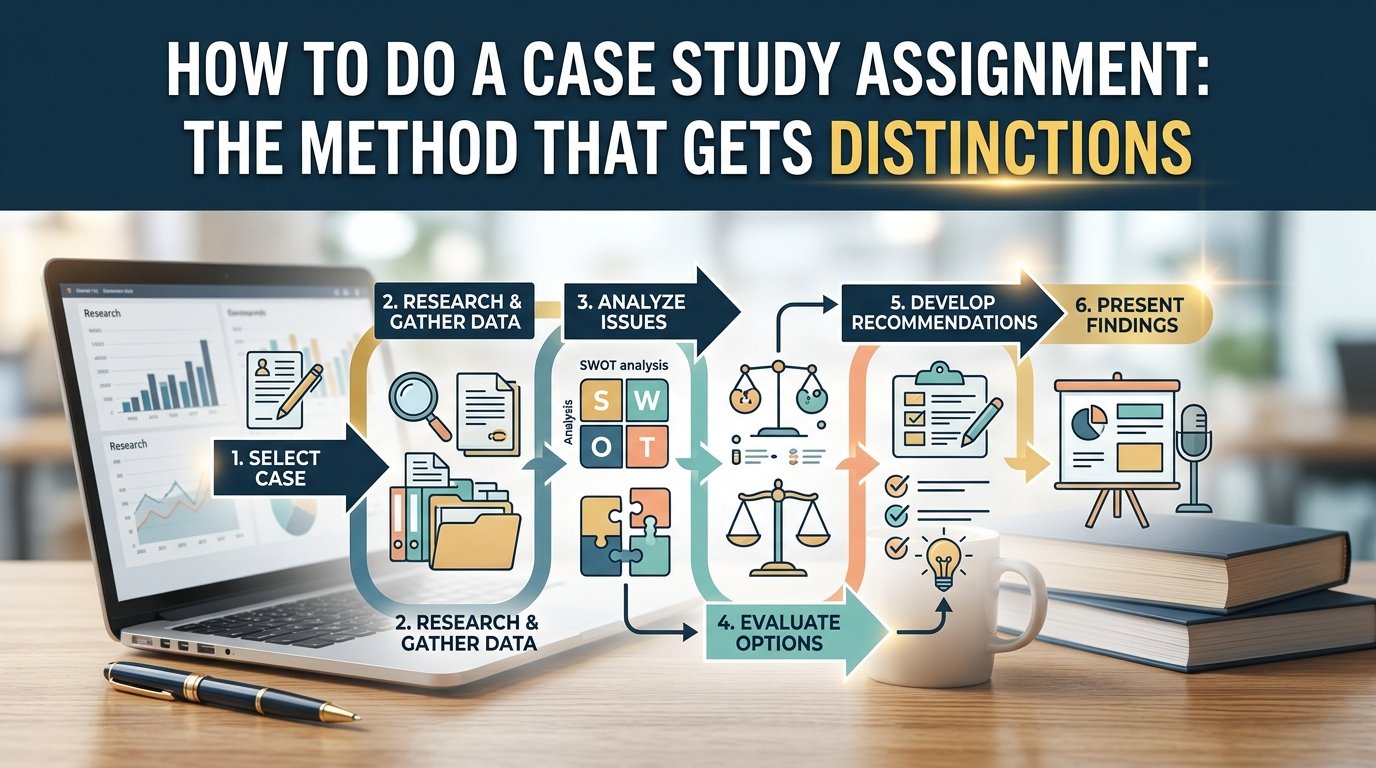
A case study assignment looks deceptively similar to an essay. Both involve reading, research, structured argument, and academic referencing. The difference that trips students up is what the assignment is actually testing. An essay tests your ability to construct an argument about a general question. A case study tests your ability to diagnose a specific, messy, real-world situation and recommend what a decision-maker should actually do about it.
That diagnostic, decision-oriented purpose changes everything about how a strong case study should be structured and argued. This guide walks through the method, how to read the case, how to identify what is actually being asked, how to structure your answer, and a full worked example applying the method to a real business scenario.
Step 1: Understand What Makes a Case Study Different From an Essay
Before writing anything, it helps to internalise three structural differences between case studies and essays, since they change how you should approach the whole assignment.
- A case study has a decision-maker. Somewhere in the case, someone (a CEO, a department head, a founder) needs to decide what to do next. Your analysis should ultimately serve that person’s decision, not just demonstrate that you understand a topic.
- A case study has constraints you cannot ignore. Real organisations have limited budgets, existing commitments, and political realities. A recommendation that ignores the constraints described in the case, however theoretically sound, reads as naive rather than sophisticated.
- A case study rewards specificity over comprehensiveness. An essay often rewards covering a topic thoroughly. A case study rewards correctly identifying the one or two issues that actually matter most and analysing those deeply, rather than superficially covering everything the case touches on.
Before analysing anything, read the case once specifically to locate these five elements:
| What to look for | Why it matters |
| Background and context | Establishes the industry, timeframe, and situation before you can judge what “success” would even mean here. |
| The decision-maker | Identify exactly whose decision this is. Your recommendation should be written for that specific person’s authority and constraints. |
| Data and evidence provided | Financial figures, market share data, or survey results in the case are there to be used as evidence, not just background reading. |
| The central tension | Most cases are built around one real tension (growth vs risk, cost vs quality). Naming it explicitly focuses your entire analysis. |
| Constraints stated in the case | Budget limits, timeline pressure, or stakeholder resistance mentioned in the case must shape a realistic recommendation. |
Step 2: Identify What Is Actually Being Asked
Case study briefs use specific language that signals what kind of answer is expected. Misreading this is one of the most common, and most avoidable, ways to lose marks before you have written a single analytical sentence.
| Brief language | What it signals |
| “Critically evaluate…” | Expects a balanced analysis weighing strengths and weaknesses, not a one-sided argument. |
| “Recommend a course of action…” | Expects a specific, actionable recommendation, not just analysis with no clear conclusion. |
| “Analyse using [named framework]…” | Expects you to explicitly apply that specific framework, not any framework you find convenient. |
| “Identify the key issues…” | Expects you to prioritise, naming which issues matter most, not list every issue the case mentions. |
| “Assess the implications of…” | Expects forward-looking analysis of consequences, not just a description of the current situation. |
Read the brief twice before you start analysing the case itself. It is surprisingly common to write a technically strong analysis that simply answers a different question from the one actually asked.
Step 3: Structure Your Answer Around Problem, Analysis, Recommendation
Regardless of which specific framework your case requires, almost every strong case study answer follows the same underlying three-part logic.
| 1
PROBLEM Name the central issue in one or two sentences. |
2
ANALYSIS Apply your framework directly to the case facts. |
3
RECOMMENDATION State what the decision-maker should do, and why. |
Problem identification
State clearly, in a sentence or two, what the central problem or decision is. This sounds simple but is where many students go wrong, either by identifying a symptom rather than the underlying problem, or by trying to address multiple unrelated problems with equal weight instead of prioritising the one the case is actually built around.
Framework-based analysis
Apply the framework your brief specifies, or an appropriate one if none is specified, directly to the specific facts in the case. This is where the bulk of your word count and marks live. The analysis should build toward your recommendation, not sit disconnected from it.
Recommendation
State what the decision-maker should actually do, specific enough to be implementable, and explicitly justified by the analysis that preceded it. A vague recommendation (“the company should improve its strategy”) is not a recommendation. A recommendation that appears without any visible connection to the analysis above it looks unearned, even if it happens to be the right call.
Worked Example: Applying the Method to a Real Scenario
Method descriptions are more useful with a real example attached. Below is a condensed application of the three-step method to a well-documented, publicly known business scenario: Uber’s 2019 acquisition of Careem’s ride-hailing operations across the Middle East.
| A note on this example: This uses only publicly reported facts about the transaction and both companies’ publicly known market positions at the time, not confidential or invented details. It illustrates the analytical method, not a claim to have inside knowledge of either company’s internal decision-making. |
| Problem identification:
The core strategic question this scenario raises for a case study is not “was the acquisition a good deal,” a purely retrospective question, but rather: what strategic logic justified Uber acquiring rather than continuing to compete directly with an established regional player that already had strong brand recognition and local market knowledge across the Middle East? Framing the problem this way, as a strategic logic question rather than a verdict question, produces a more analytically interesting answer. |
| Framework-based analysis:
Applying Porter’s Five Forces to the pre-acquisition competitive landscape, the dominant force was rivalry between Uber and Careem specifically, both well-funded, both pursuing the same regional customer base, in a market where switching costs for riders were genuinely low. This intensity of direct rivalry, rather than supplier power or substitute threat, is what makes acquisition a more strategically logical response than continued price competition: acquiring a rival directly neutralises the dominant competitive force rather than attempting to out-compete it indefinitely, which regional ride-hailing markets have shown can be extremely costly for both parties through sustained subsidy wars. |
| Recommendation (framed as the strategic lesson):
For a case study answer, the recommendation section would translate this analysis into a generalisable strategic principle: in markets characterised by intense two-player rivalry with low switching costs and high customer acquisition subsidy costs, acquisition of the rival can represent a more capital-efficient path to market position than sustained price competition, provided the acquiring company’s valuation of the synergy (in this case, combined market share and reduced subsidy burden) exceeds the acquisition premium paid. A strong answer would then apply this principle back to whatever specific decision the actual assignment brief is asking about. |
Notice the shape of this worked example: a specific problem framing, an analysis that uses a named framework to explain why one force dominated the situation, and a recommendation that is explicitly derived from, not disconnected from, that analysis. This is the shape markers are looking for regardless of which specific case or framework your own assignment requires.
A second worked example: noon.com (UAE)
A different type of case, competing against a much larger global incumbent rather than a well-matched regional rival, calls for a different analytical lens. Below is a condensed application of the same three-part method to noon.com, the UAE-headquartered e-commerce platform, and its competitive position against Amazon in the regional market.
| A note on this example: As with the previous example, this uses only publicly known facts about noon.com’s market position and business model, not confidential or invented details. |
| Problem identification:
The strategic question is not “can a regional platform survive against Amazon,” a binary survival question, but rather: what specific sources of local advantage, if any, allow a regional e-commerce platform to defend market position against a global incumbent with vastly greater capital and logistics scale? Framing it this way directs the analysis toward identifiable, defensible advantages rather than a general discussion of competitive intensity. |
| Framework-based analysis (SWOT/TOWS):
A strength specific to a UAE-headquartered platform, deep familiarity with regional payment preferences (including cash on delivery, which remained significant in parts of the regional market), local language support, and region-specific logistics infrastructure, can be paired with an opportunity (continued underpenetration of e-commerce relative to more mature markets) to generate an SO strategy: deepening category specialisation in areas where regional consumer preference diverges from global platform defaults, rather than attempting to out-scale a global competitor directly on breadth or price alone. |
| Recommendation (framed as the strategic lesson):
For a case study answer, this translates into a generalisable principle: regional platforms competing against global incumbents are better served by defending and deepening specific, locally-grounded advantages (payment methods, language, logistics familiarity) than by competing directly on the incumbent’s own scale-driven terms, such as price or product breadth alone. A strong answer would then apply this same logic to whichever specific competitive scenario the actual assignment brief describes. |
Common Mistakes: Description Instead of Analysis
The single most common note markers write on case study feedback is some version of “this is descriptive, not analytical.” The distinction is specific and learnable.
- Descriptive: “The company faced increased competition from new market entrants.” Analytical: “The company’s premium pricing strategy became unsustainable once new entrants offered comparable quality at 30% lower prices, directly eroding the price-based differentiation the original strategy depended on.”
- Descriptive: restating facts already given in the case as if they were original findings.
- Analytical: using those same facts as evidence within an argument that reaches a conclusion the case itself does not state explicitly.
- A useful self-check: if a sentence in your case study could be lifted directly from the case document itself with only minor rewording, it is likely description. If a sentence draws a conclusion or connection that required your own reasoning to produce, it is likely analysis.
Referencing: Harvard vs APA for Business Case Studies
UAE business schools vary in which referencing style they require for case study work, and the two most common, Harvard and APA, differ in several details that matter for marks.
| Element | Harvard style | APA style |
| In-text citation | (Smith, 2023) | (Smith, 2023) |
| Multiple authors (in-text) | (Smith and Jones, 2023) | (Smith & Jones, 2023) |
| Reference list heading | “References” or “Bibliography” | “References” |
| Author name order in list | Surname, Initial. | Surname, Initial. |
| Direct quote page reference | (Smith, 2023, p.45) | (Smith, 2023, p. 45) |
Confirm which style your specific institution and module require before you start referencing, since switching styles partway through a document is a common and easily avoidable way to lose formatting marks. Most UAE business schools specify Harvard referencing for undergraduate work, with some MBA programmes and specific journals requiring APA instead.
Need Help With Your Case Study Assignment?
Our strategic management writers apply this exact method, problem identification, framework-based analysis, and a justified recommendation, to case studies across every business discipline. Every completed assignment includes a Turnitin originality report.