

By the EssaySouq Engineering Team | Reviewed by writers holding Masters and PhD engineering qualifications with UAE industry experience
Last updated: June 2026 | 16 min read
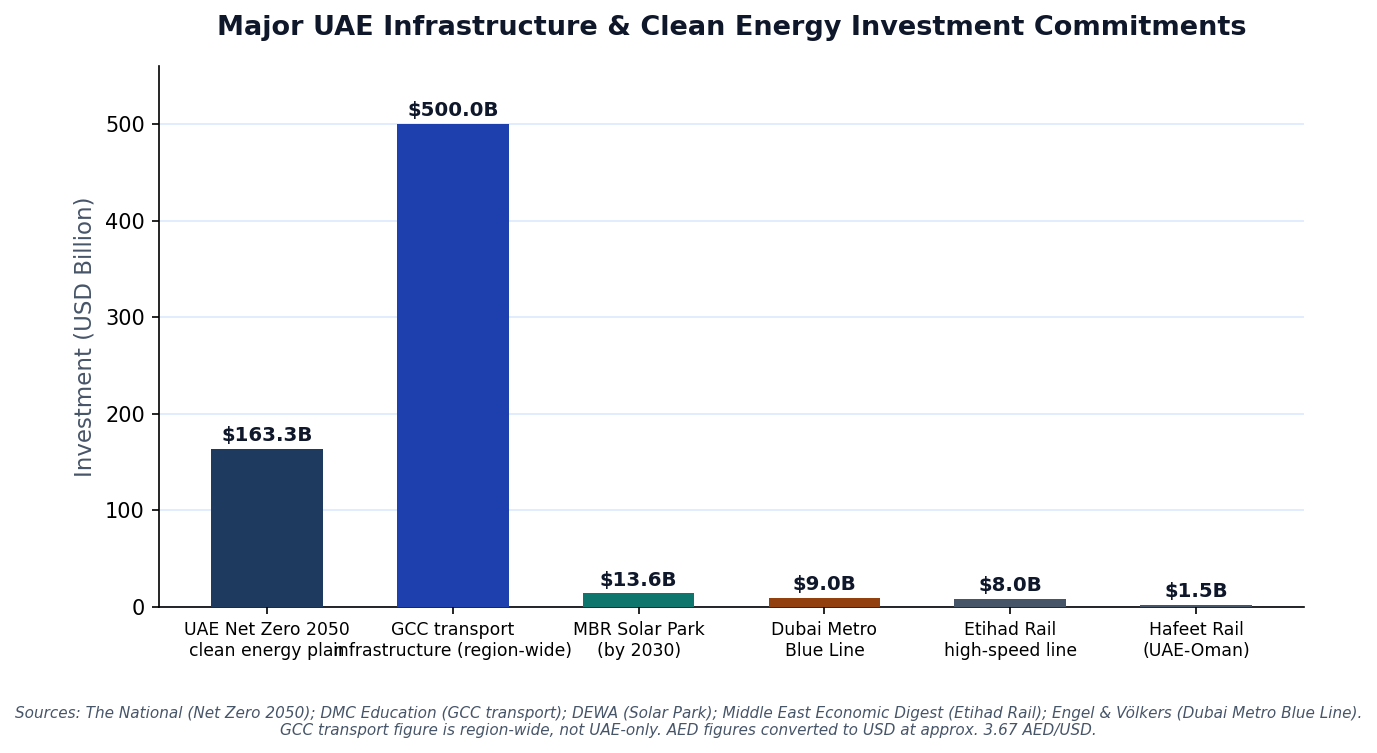
The UAE’s engineering job market is being reshaped by an infrastructure pipeline of extraordinary scale. The Gulf Cooperation Council is investing more than USD 500 billion in transportation infrastructure alone in the coming years, and within the UAE specifically, Etihad Rail has awarded contracts worth over USD 8 billion for its Abu Dhabi to Dubai high-speed line, while the Dubai Metro Blue Line represents a further USD 9 billion investment. Add the UAE’s AED 600 billion Net Zero 2050 clean energy commitment, and it is clear why certified, credentialed engineers are in genuine demand across the country in 2026.
Whether you are an engineering student in the UAE or a working professional deciding which credential to pursue next, this guide compares the leading engineering certifications available in 2026: PE, CEng, PMP, NEBOSH, and LEED AP, so you can choose the one that best matches your discipline and career goals.
| Struggling with your engineering assignments in the UAE?
EssaySouq’s engineering writers, several with Masters and PhD qualifications, are available 24/7 across aerospace, mechanical, civil, and electrical disciplines. |
This guide was compiled by our engineering support team, who work daily with UAE-based engineering students across aerospace, mechanical, civil, and electrical disciplines and regularly field questions from students and working professionals about which professional certification actually makes sense for their specific career direction. Every figure below is drawn from a named, verifiable source, cross-checked against multiple UAE recruitment and salary data providers where possible, and clearly flagged where UAE-specific data was not available.
Best Time to Pursue an Engineering Certification in the UAE
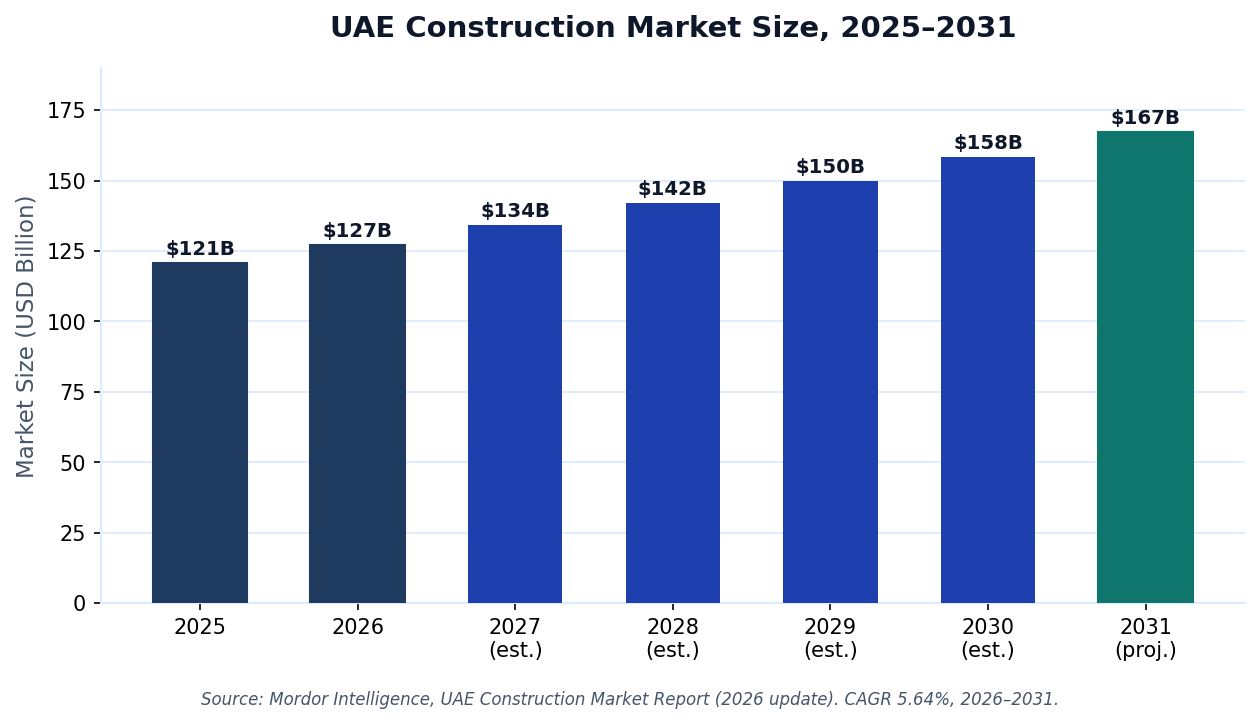
The scale of current and planned UAE infrastructure investment has created sustained, structural demand for certified engineers across nearly every discipline.
Key market indicators driving engineering certification demand in the UAE in 2026:
- The GCC is investing more than USD 500 billion in transportation infrastructure projects, including metro systems, passenger rail corridors, and airport infrastructure, according to regional infrastructure analysis published by DMC Education
- Etihad Rail has awarded design and construction contracts worth over USD 8 billion for the UAE’s first high-speed rail line connecting Abu Dhabi and Dubai, scheduled to become operational in 2030, according to Middle East Economic Digest
- The Dubai Metro Blue Line represents an investment of approximately USD 9 billion, adding 30 kilometres of new track and 14 new stations by 2029
- The Mohammed bin Rashid Al Maktoum Solar Park, the world’s largest single-site solar park, has a planned capacity of 5,000MW by 2030 with investments of up to AED 50 billion, according to Dubai Electricity and Water Authority (DEWA)
- The UAE has committed to invest approximately AED 600 billion in clean energy projects as part of its Net Zero 2050 strategy, reported by The National
- PMP-certified professionals in the UAE now number more than 23,670, ranking the UAE eighth globally for active PMP certifications, according to data reported by Khaleej Times in December 2025
- PMP-certified professionals report a 17% higher median salary than non-certified peers globally, according to PMI’s 14th Edition Salary Survey (2025)
Put simply, the UAE’s infrastructure ambitions have created genuine, sustained demand for engineers who can prove their competence through recognised certification.
1. PE: Professional Engineer (USA)
| Best for: Engineers, particularly in oil and gas, targeting US-headquartered employers or roles requiring the legal authority to stamp and seal engineering designs.
Key facts:
Salary in the UAE:
Career roles: Design Engineer, Structural Engineer, Petroleum Engineer, Consulting Engineer, independent engineering consultant. PE is most valuable in the UAE specifically for engineers targeting US-headquartered firms or roles where US design standards and codes are the governing framework, common in parts of the oil and gas sector. |
2. CEng: Chartered Engineer (UK)
| Best for: Engineers in the UAE whose degree or early career followed a UK-accredited pathway, seeking the credential most directly aligned with UK engineering standards still widely used across UAE consulting and construction.
Key facts:
Salary in the UAE:
Career roles: Chartered Structural Engineer, Chartered Mechanical Engineer, Principal Engineer, Engineering Consultant, Technical Director. For UAE-based engineers who studied on a UK-accredited degree pathway, which describes a substantial share of the region’s engineering workforce, CEng is often the most natural and directly relevant chartered credential to pursue. |
3. PMP: Project Management Professional
| Best for: Engineers moving into project leadership roles on the UAE’s large infrastructure, construction, and industrial projects, arguably the single most in-demand credential for engineers in the UAE right now.
Key facts:
Salary in the UAE:
Career roles: Project Manager, Senior Project Manager, Project Director, Programme Manager, Construction Project Manager. Given the sheer scale of UAE infrastructure investment currently underway, PMP is arguably the single most commercially valuable certification an engineer in the UAE can add alongside their core technical qualification. |
4. NEBOSH: National Examination Board in Occupational Safety and Health
| Best for: Engineers moving into health, safety, and environmental (HSE) roles, especially relevant given the UAE’s continued construction and industrial project volume.
Key facts:
Salary in the UAE:
Career roles: HSE Officer, HSE Coordinator, Senior Safety Officer, HSE Manager, HSE Director. For engineers with construction, oil and gas, or industrial backgrounds, pairing a core engineering qualification with NEBOSH opens a genuinely distinct, well-compensated career track focused on safety leadership rather than pure technical design. |
5. LEED AP: LEED Accredited Professional
| Best for: Engineers and built-environment professionals targeting the UAE’s fast-growing sustainable construction and green building sector, directly aligned with national sustainability strategy.
Key facts:
Salary in the UAE:
Career roles: Sustainability Engineer, LEED Consultant, Green Building Coordinator, ESG Consultant, Renewable Energy Project Engineer. Given the UAE’s binding Net Zero 2050 commitment and the Dubai Municipality’s own BIM and green building mandates for large developments, LEED AP is one of the clearest long-term growth credentials available to engineers in the region, even without a single definitive UAE salary study yet published. |
6. MEP Certification: CIBSE and ASHRAE
MEP, Mechanical, Electrical, and Plumbing engineering, deserves its own entry rather than a mention in passing, because it is arguably the single most construction-specific engineering discipline in the UAE, and the one where certification requirements are most directly tied to actual project approval processes rather than general career advancement.
| Best for: Engineers working specifically on building services design and coordination for UAE construction and real estate projects, one of the largest and most consistently active engineering employment segments in the country.
Key facts:
Salary in the UAE:
Career roles: MEP Engineer, HVAC Design Engineer, Electrical Design Engineer, MEP Coordinator, MEP Project Manager, Building Services Engineer. For engineers specifically targeting UAE construction and real estate, arguably the sector with the single largest volume of ongoing engineering hiring in the country, MEP-specific credentials (CIBSE, ASHRAE, alongside LEED AP) are frequently more directly relevant to day-to-day employability than a broader chartered credential like CEng or PE alone. |
Quick Comparison: Best Engineering Certifications for UAE Professionals (2026)
Here is a side-by-side comparison to help you decide:
| Certification | Issuing Body | Focus | UAE Relevance | Best For |
| PE | NCEES / US state boards | Design authority, licensure | Moderate, strongest at US-affiliated firms | Oil & gas, US-standard design work |
| CEng | UK institutions (IMechE, ICE, IET) | Chartered professional status | High, given UK-accredited degree prevalence | UK-pathway engineers, consulting |
| PMP | PMI (USA) | Project leadership | Very High, 8th globally for active holders | Infrastructure and construction PM roles |
| NEBOSH | NEBOSH (UK) | Health, safety, environment | Very High across construction and oil & gas | HSE career track |
| LEED AP | USGBC (USA) | Sustainable building design | High and growing, tied to Net Zero 2050 | Green building, sustainability roles |
| MEP (CIBSE/ASHRAE) | CIBSE (UK) / ASHRAE (USA) | Building services design | Very High, tied directly to construction volume | HVAC, electrical & plumbing design |
Where Are UAE Employers Hiring Certified Engineers?
Understanding which employers actively recruit certified engineers in the UAE helps you target your certification choice and job search more effectively.
ADNOC
Abu Dhabi National Oil Company, established in 1971 and government-owned, is one of the world’s largest energy companies and among the UAE’s most active engineering employers in 2026, with current vacancies spanning process safety engineering, plant operations, electrical maintenance, drilling, and reservoir simulation across ADNOC Distribution, ADNOC Drilling, ADNOC Logistics and Services, and ADNOC Onshore. ADNOC operates one of the UAE’s most active Emiratisation programmes, with UAE Nationals given strong priority across all entities and grades, and non-UAE Nationals typically considered only where specific technical expertise is required. For project management roles specifically, ADNOC explicitly asks candidates to include their PMP or equivalent certification details, and for drilling and field roles, IWCF and BOSIET certifications are expected alongside core engineering qualifications.
DEWA (Dubai Electricity and Water Authority)
DEWA is the driving force behind the Mohammed bin Rashid Al Maktoum Solar Park and Dubai’s broader clean energy transition, and as the utility responsible for delivering the emirate’s Net Zero Carbon Emissions Strategy 2050, it maintains substantial in-house engineering capacity across power generation, water infrastructure, and renewable energy project delivery.
Beyond these two entities, Etihad Rail’s ongoing national rail programme and the major EPC contractors delivering the UAE’s current infrastructure pipeline, commonly including firms with backgrounds at Petrofac and Technip on ADNOC-related projects, represent the largest concentration of active engineering recruitment in the country through 2026 and beyond.
The Renewable Energy and Green Building Boom
The UAE’s Net Zero 2050 commitment is creating an entirely new category of engineering roles that combine traditional technical disciplines with sustainability credentials.
Mohammed bin Rashid Al Maktoum Solar Park
The world’s largest single-site solar park, developed by DEWA using the Independent Power Producer model in partnership with international developers including Saudi Arabia’s ACWA Power, has already attracted approximately AED 40 billion in investment through public-private partnerships, according to DEWA’s own reporting, with a planned total capacity of 5,000MW by 2030. Projects of this scale require sustained engineering recruitment across solar photovoltaic design, grid integration, and project engineering roles.
Green building consulting
LEED and Estidama-focused consultancies are expanding across Dubai and Abu Dhabi as sustainability requirements tighten, and Dubai Municipality’s BIM mandate for large buildings has become a standard requirement, creating consistent demand for engineers who combine core technical qualifications with green building credentials specifically. Savills Middle East reports that LEED-certified buildings in the UAE now command higher rental premiums and faster occupancy rates, a market signal that is likely to sustain demand for LEED AP-credentialed professionals over the coming years.
How UAE Infrastructure Investment Is Reshaping the Engineering Job Market
The scale of current UAE infrastructure spending is creating structural, multi-year demand across engineering disciplines rather than a short-term hiring spike. Etihad Rail’s passenger operations are launching in phases throughout 2026, connecting Abu Dhabi, Dubai, Sharjah, Fujairah, and several other emirates for the first time via national rail, while the Abu Dhabi to Dubai high-speed line, with over USD 8 billion in contracts already awarded, targets operation by 2030 at speeds up to 350 km/h.
Parallel to this transport investment, the UAE’s AED 600 billion Net Zero 2050 clean energy commitment is driving sustained recruitment in renewable energy engineering specifically, while continued urban expansion under the Dubai 2040 Urban Master Plan, including major projects such as the Dubai Metro Blue Line and new waterfront developments including Palm Jebel Ali and Dubai Islands, sustains demand across civil, structural, and MEP engineering disciplines more broadly.
This combination, transport infrastructure, renewable energy, and continued urban development, means the UAE’s current engineering hiring boom is unusually broad across disciplines rather than concentrated in a single sector, which is one reason certification choice matters: the right credential should match not just your current discipline, but which of these three investment streams you want your career to track.
Which Engineering Certification Is Right for You in the UAE?
Here is a simple decision guide based on your career goals:
- You want to move into project leadership on large UAE infrastructure projects: Choose PMP. It is the most in-demand credential across UAE engineering right now, with the UAE ranking eighth globally for active certifications.
- Your degree followed a UK-accredited engineering pathway: CEng, pursued through IMechE, ICE, IET, or IChemE depending on your discipline, is the most natural chartered credential to target.
- You are targeting US-headquartered oil and gas or EPC firms specifically: PE gives you the strongest alignment with US design standards and codes still used across parts of the sector.
- You want to move from pure technical engineering into health and safety leadership: NEBOSH, starting with the IGC, is the clearest entry point into a genuinely distinct and well-compensated HSE career track.
- You want to specialise in sustainable construction and green building: LEED AP is the strongest fit given the UAE’s binding Net Zero 2050 commitments, alongside Estidama if you plan to work primarily in Abu Dhabi.
- You want to work specifically on building services design for UAE construction and real estate projects: CIBSE or ASHRAE, the two certifications most directly tied to actual MEP project approval processes, are the most relevant given how large and consistently active this segment of UAE engineering hiring is.
- You are early in your career and unsure which discipline to specialise in: PMP is the most broadly applicable choice, since project management skills transfer across every engineering discipline and every major UAE infrastructure sector currently hiring.
Struggling With Your Engineering Assignments in the UAE?
Balancing a demanding engineering degree, professional certification study, and life in the UAE is genuinely difficult. That is where EssaySouq comes in.
Our engineering writers, several holding Masters and PhD qualifications with direct industry experience, support students across aerospace, mechanical, civil, and electrical disciplines, including specialist support for Avionics Systems, MATLAB simulations, structural analysis, and CAD-based design assignments. Every completed assignment includes a Turnitin originality report.
About This Guide: Sources and Limitations
Every statistic in this guide is drawn from a specific, named source rather than estimated or generalised. Infrastructure and investment figures come from DMC Education, Middle East Economic Digest, DEWA, and The National. Certification and salary data comes from PMI’s official Salary Survey, NCEES and the US Bureau of Labor Statistics, IMechE and the Engineering Council, HSE Study Guide, Asanify, RFSonSHR, and UAE recruitment platforms including Bayt, GulfTalent, and LinkedIn Salary Insights.
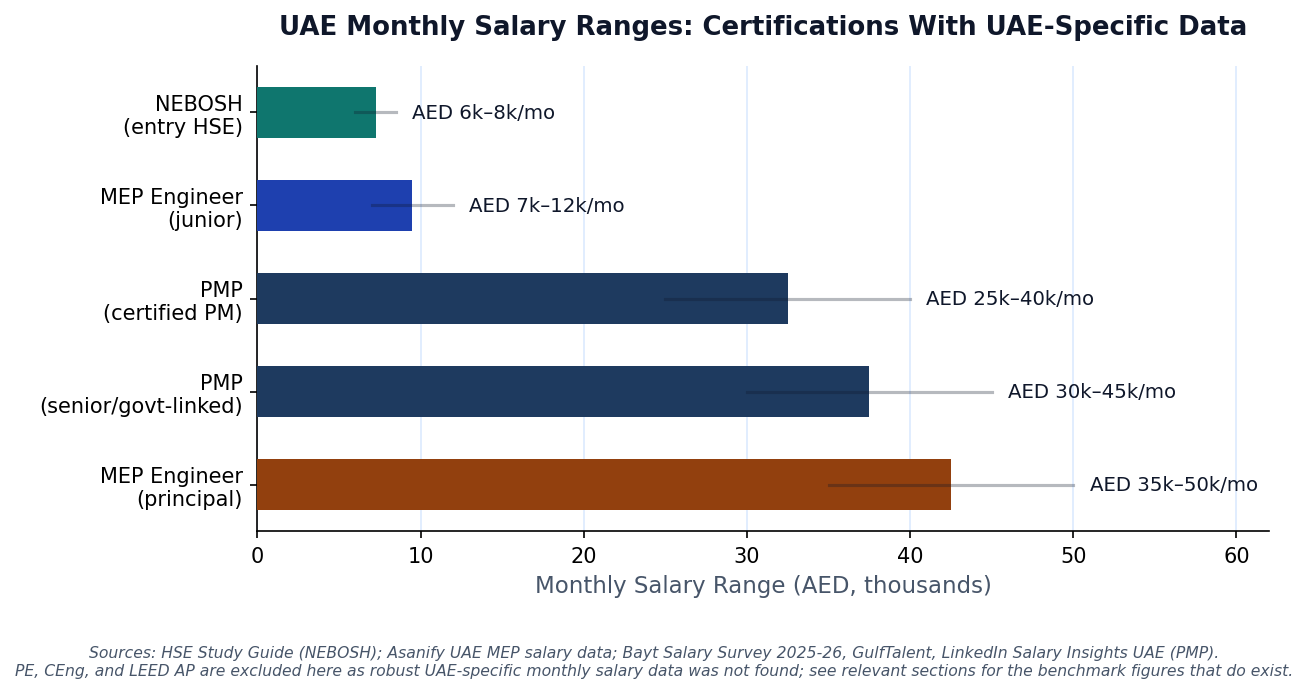
Where robust UAE-specific data was not available, this guide says so directly rather than substituting a global or regional figure without labelling it. This applies specifically to PE and CEng monthly salary premiums in the UAE, and to LEED AP salary data, all three are noted as data gaps in their respective sections above, and the salary comparison chart in this guide deliberately excludes them rather than implying figures that do not exist.
This guide reflects data available as of June 2026. Certification requirements, salary ranges, and infrastructure investment figures change; we recommend verifying current figures directly with the relevant certifying body or a current UAE salary survey before making a certification decision based on compensation alone.
Frequently Asked Questions About Engineering Certifications in the UAE
Which engineering certification is most in demand in the UAE?
PMP is currently the most broadly in-demand certification for engineers in the UAE, given the sheer scale of infrastructure investment underway. The UAE ranks eighth globally for active PMP certifications with more than 23,670 certified professionals as of late 2025. NEBOSH is similarly strong for engineers moving into HSE roles, given continued high construction and oil and gas activity.
Is a US PE license recognised in the UAE?
The PE license itself is a US state-based credential without automatic recognition in the UAE, but it is genuinely valued and often specifically sought by US-headquartered engineering and EPC firms operating in the region, particularly within oil and gas, where US design codes and standards remain common.
Should I pursue CEng or PMP first as a UAE-based engineer?
This depends on your career direction. CEng validates deep technical and chartered professional status within your specific engineering discipline. PMP validates project leadership capability that applies across disciplines and is currently the single most requested credential on UAE infrastructure and construction project postings. Many senior UAE engineers eventually hold both.
Do I need a specific MEP certification, or does a general engineering degree cover it?
A general mechanical or electrical engineering degree is the starting requirement, but MEP-specific work in the UAE increasingly expects CIBSE or ASHRAE credentials alongside it, particularly for HVAC design roles, along with proven Revit MEP or AutoCAD MEP proficiency. Many UAE emirates also require MEP engineers to register directly with the relevant authority, such as DEWA in Dubai, so a general engineering qualification alone is often not sufficient for senior MEP design responsibility.
How is the UAE’s Net Zero 2050 strategy affecting engineering hiring?
It is creating sustained demand for engineers with renewable energy, sustainable construction, and green building expertise specifically. The UAE has committed approximately AED 600 billion to clean energy projects, and LEED-certified buildings already command rental premiums in the UAE market, according to Savills Middle East, a signal that sustainability-credentialed engineers will remain in strong demand through the coming years.
Can I study for these certifications while working full-time as an engineer in the UAE?
Yes. PMP, NEBOSH, and LEED AP are all commonly studied part-time alongside full-time employment, with UAE-based and online training providers offering evening and weekend formats. CEng and PE both require a longer accumulation of verified professional experience alongside formal application and exam requirements, so these typically progress over several years of a working career rather than through short-term intensive study.
How can EssaySouq help with my engineering studies in the UAE?
EssaySouq provides expert engineering assignment support across aerospace, mechanical, civil, and electrical disciplines, delivered by writers with Masters and PhD qualifications and direct industry experience. We support coursework, lab reports, CAD and MATLAB-based assignments, and technical report writing, with every completed assignment including a Turnitin originality report.
Final Thoughts: Your Engineering Career in the UAE Starts Now
The UAE in 2026 offers an unusually broad engineering opportunity, driven simultaneously by a national rail programme, continued urban mega-project development, and a binding Net Zero 2050 clean energy commitment. Whether you pursue PMP for its unmatched breadth of current demand, CEng for chartered recognition tied to a UK-accredited pathway, PE for US-aligned oil and gas work, NEBOSH for a distinct HSE career track, or LEED AP for the region’s fast-growing sustainability sector, the underlying market conditions genuinely support the investment.
EssaySouq is your trusted partner for engineering assignment help and academic support across the UAE, from Dubai and Abu Dhabi to Sharjah and Al Ain. Contact EssaySouq today, available 24/7 for UAE students.