

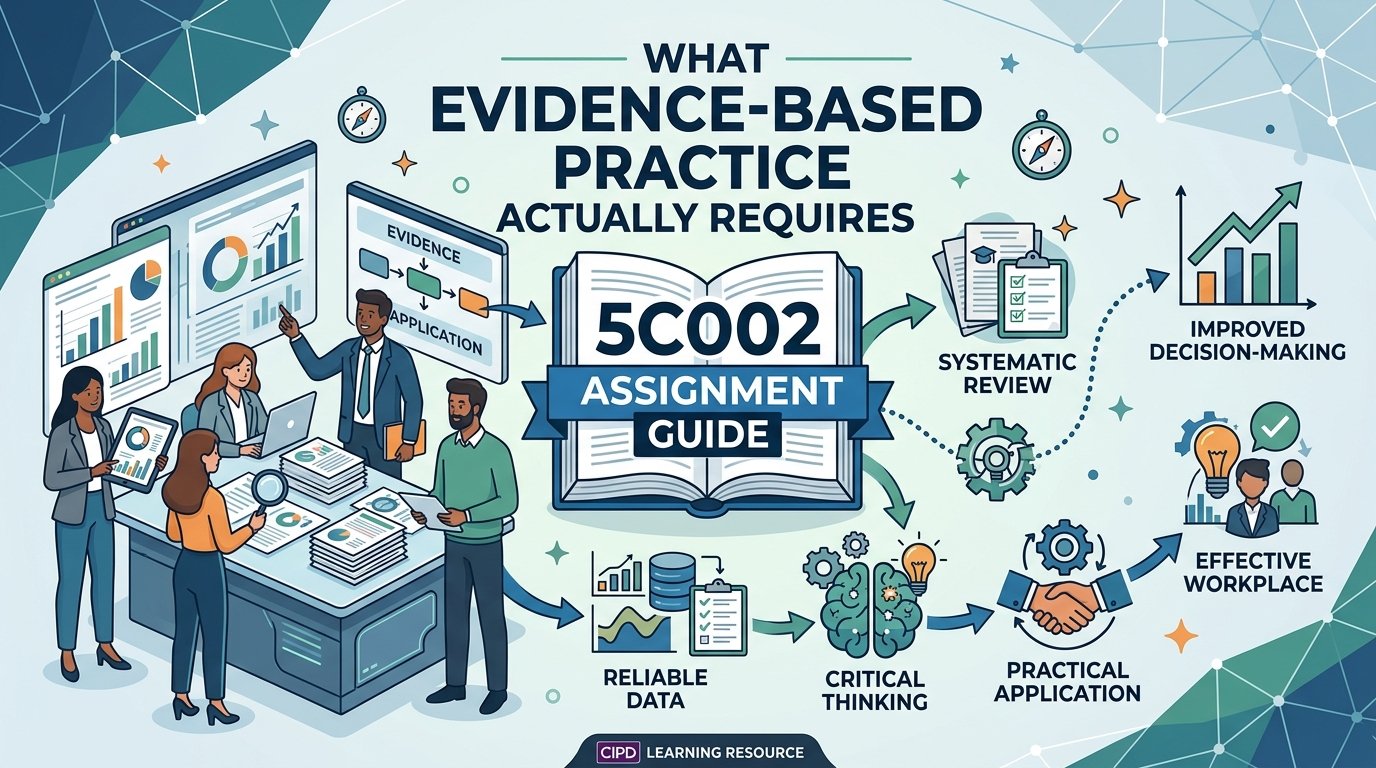
If you ask a group of CIPD Level 5 students which unit worries them most, 5CO02 comes up more than any other. Not because the content is obscure, most students have used data and research in some form throughout their careers, but because the unit assesses a specific skill, critical evaluation, that is genuinely different from anything Level 3 or the other Level 5 core units ask for.
This guide breaks down what each assessment criterion in 5CO02 is actually checking for, the exact difference between summarising evidence and evaluating it, and where most students lose marks before they have even reached their conclusion.
| Quick note before we start: This guide covers what markers are looking for so you can strengthen your own answer. Prefer to have an expert write it for you? Our CIPD team covers 5CO02 directly, and a full completed 5CO02 sample is available to review before you order. |
What 5CO02 Actually Covers
Evidence-Based Practice sits among the three core Level 5 units everyone completes, regardless of specialist pathway. It is built around three connected skills: undertaking research and analysis ethically and inclusively, applying critical thinking when reviewing sources and evidence, and interpreting data to produce insights that actually inform a decision.
The unit is not testing whether you can find research. It is testing whether you can judge it, weigh its strengths and limitations, and use it to build a genuinely evaluative argument rather than a well-organised summary.
The Assessment Criteria, and What Each One Is Actually Checking For
| AC | What it asks | What the marker is checking for |
| AC1.1 | Analyse different forms of primary and secondary research | Distinguish clearly between primary research (surveys, interviews you or your organisation conducted) and secondary research (existing published studies), and explain the specific strengths and limitations of each, not just define them. |
| AC1.2 | Explain how ethical, inclusive research and analysis principles can be applied | Reference specific ethical principles, informed consent, confidentiality, avoiding bias in sampling, applied to a concrete research scenario rather than described in the abstract. |
| AC1.3 | Explain the importance of using contextual information to inform decision-making | Show how the same piece of evidence might lead to different conclusions depending on organisational context, not just state that context matters. |
| AC2.1 | Explain the importance of critical thinking when reviewing information and data | Go beyond stating that critical thinking is important; demonstrate it, by showing what a critical versus uncritical reading of the same evidence would each conclude. |
| AC2.2 | Assess different research approaches | Compare specific approaches (quantitative versus qualitative, or particular methods within each) against a specific research question, not a generic list of pros and cons. |
| AC2.3 | Explain how to identify reliable evidence sources | Name specific credibility markers (peer review, sample size, methodology transparency, potential conflicts of interest) rather than a vague statement that sources should be “reliable.” |
| AC3.1 | Analyse data to provide meaningful insight and interpretation | This is where description most often gets mistaken for analysis. Markers want the “so what,” what does this data actually mean for the organisation, not just what the data shows. |
| AC3.2 | Choose appropriate methods to communicate insights and recommendations to stakeholders | Justify the specific communication method chosen (a dashboard, a written report, a presentation) against the specific stakeholder audience, rather than describing communication methods generically. |
Notice the pattern: almost none of these criteria are asking you to define a term. AC2.2 wants comparison, AC3.1 wants interpretation, AC1.2 wants application. A definition-only answer, however accurate, cannot reach the marks available for critical evaluation.
The Skill That Actually Separates a Pass From a Distinction
Almost every piece of 5CO02 feedback that comes back with a resubmission request says some version of the same thing: description, not evaluation. The distinction is specific and learnable.
| Weaker (description):
A survey found that 68% of employees who received regular feedback reported higher engagement. This shows feedback improves engagement. |
| Stronger (evaluation):
A survey found that 68% of employees who received regular feedback reported higher engagement. However, the survey relied on self-reported engagement measured immediately after a feedback session, which may capture a short-term response rather than a sustained change, and the sample was drawn from a single organisation with an already strong feedback culture, limiting how confidently this finding generalises to organisations just beginning to introduce structured feedback. |
The stronger version reports the same finding but interrogates the methodology (self-reported, immediate timing) and the context (single organisation, pre-existing culture) before drawing a conclusion. That interrogation, not the finding itself, is what 5CO02 is actually assessing.
Common Mistakes in 5CO02 Assignments
1. Summarising sources instead of evaluating them
The most common pattern, covered in detail above. If a sentence in your assignment could be lifted directly from the source with only minor rewording, it is summary. If it required your own judgement to produce, it is evaluation.
2. Treating all evidence as equally credible
AC2.3 specifically wants you to differentiate reliable from less reliable sources. An assignment that cites a peer-reviewed study and an unreferenced blog post with the same level of confidence has missed this criterion entirely, regardless of how the rest of the assignment reads.
3. Generic data interpretation with no organisational context
AC3.1 wants insight specific to a decision an organisation would actually need to make. “The data shows engagement is low” is not insight. “The data shows engagement is lowest specifically among employees with under two years of tenure, suggesting onboarding rather than general culture may be the more targeted intervention point” is.
4. Ignoring research ethics
AC1.2 is frequently under-addressed. Even a brief, specific mention of informed consent or data confidentiality in your research scenario is better than omitting ethical considerations entirely, which is a common and avoidable gap.
Related CIPD Guides
If you are working through the full Level 5 qualification, these guides cover other units in the same depth as this one.
- 5HR01 Employment Relationship Management: our full AC-by-AC breakdown for the most frequently requested Level 5 unit.
- The Complete Guide to CIPD Level 5 Assignments: a working overview of all eight Level 5 units if you have not yet identified which one needs your attention.
Need Help With Your 5CO02 Assignment?
Our CIPD team covers 5CO02 and every other Level 3, 5, and 7 unit, with writers who hold CIPD qualifications and know exactly what critical evaluation looks like at distinction level. A completed 5CO02 sample is available to review, and every assignment includes a Turnitin originality report.