

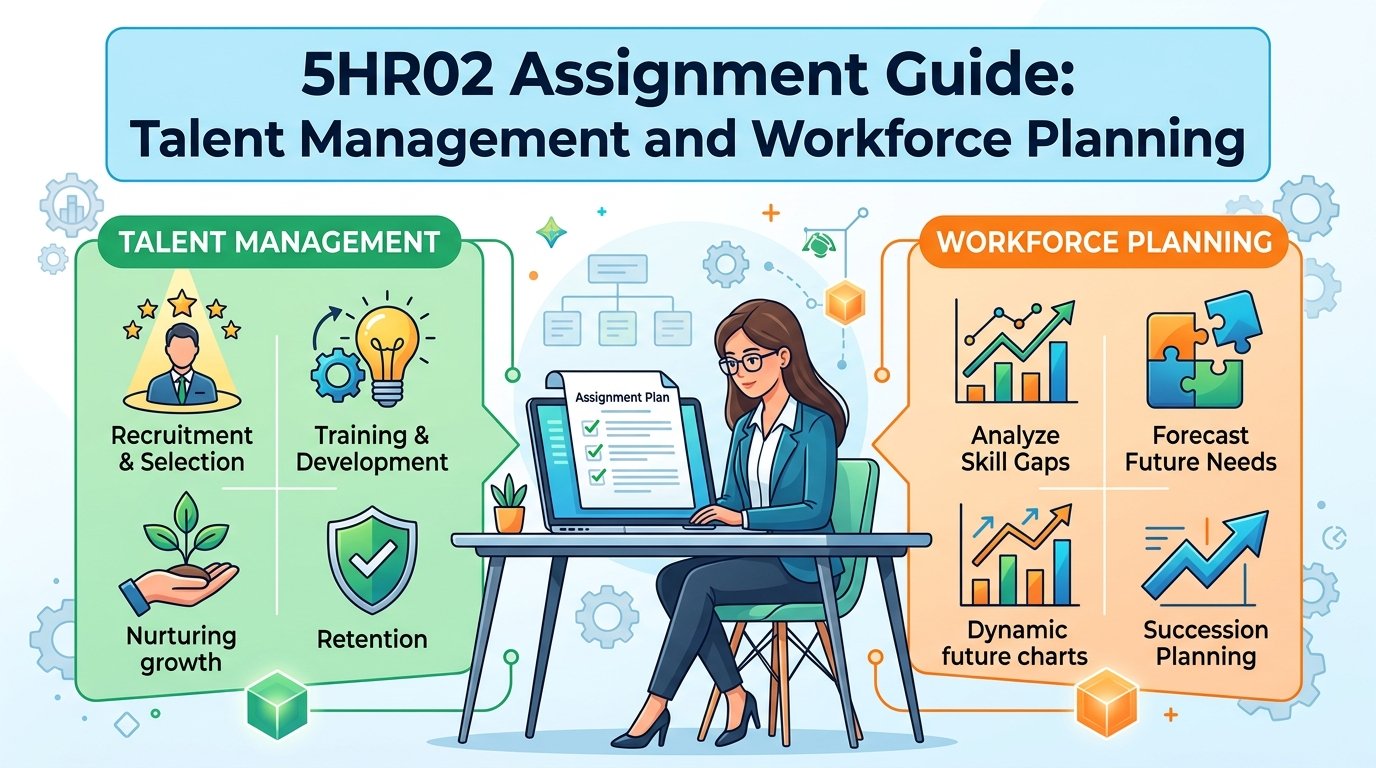
5HR02 asks students to do something most have not formally practised before: apply an actual workforce planning tool to a real or realistic scenario, rather than describe talent management in general terms. This is where the unit most often loses students marks, not because the concepts are unfamiliar, but because “describing talent management” and “applying a workforce planning tool” are different skills, and the assessment criteria consistently reward the second one.
This guide breaks down what each assessment criterion is checking for, how to actually apply a workforce planning tool rather than just name it, and the specific mistakes that show up most often in 5HR02 submissions.
| Quick note before we start: This guide covers what markers are looking for so you can strengthen your own answer. Prefer to have an expert write it for you? Our CIPD team covers 5HR02 directly, and a full completed 5HR02 sample, a workforce demand and supply analysis for a UAE financial services organisation, is available to review before you order. |
What 5HR02 Actually Covers
Talent Management and Workforce Planning is a specialist Level 5 unit sitting alongside 5HR01 and 5HR03 in the HR-specific pathway. It covers three connected areas: the internal and external factors shaping an organisation’s workforce planning, the legal and practical considerations in recruitment and selection, and approaches to talent management and workforce development once people are in the organisation.
The throughline across all three areas is application. Markers are consistently looking for a named tool or framework applied to a specific scenario, not a general discussion of why talent management matters.
The Assessment Criteria, and What Each One Is Actually Checking For
| AC | What it asks | What the marker is checking for |
| AC1.1 | Assess the internal and external factors that impact an organisation’s talent planning | Name specific factors (skills shortages, demographic shifts, Emiratisation targets for UAE-based organisations) and explain their specific effect on planning, not a generic PESTLE-style list. |
| AC1.2 | Explain labour market trends that inform recruitment and retention approaches | Connect a specific, current labour market trend to a specific recruitment or retention implication, rather than describing trends in isolation from their organisational effect. |
| AC2.1 | Explain the legal requirements relating to recruitment and selection | Reference specific legislation (UK employment and equality law, since CIPD is UK-regulated) applied to a specific stage of the recruitment process, not a general statement that recruitment must be legally compliant. |
| AC2.2 | Compare the strengths and weaknesses of different recruitment and selection methods | Genuine comparison between named methods (structured interviews, assessment centres, psychometric testing) against a specific role type, not a list of methods with generic pros and cons attached. |
| AC3.1 | Explain the concept of workforce segmentation and its relationship to talent management | Apply segmentation to a specific organisational example, showing which employee groups might be prioritised differently and why, rather than defining segmentation abstractly. |
| AC3.2 | Explain approaches to succession and workforce planning | Apply an actual planning tool, a demand and supply analysis, a succession pipeline model, to a specific scenario. This is the criterion where naming a tool without applying it costs the most marks. |
AC3.2 deserves particular attention. It is consistently the criterion where students lose the most marks, because naming “workforce planning” or “succession planning” as a concept is not the same as demonstrating the tool in use against real or realistic numbers.
Applying a Workforce Planning Tool Properly
The skill AC3.2 is actually testing is best shown directly rather than described abstractly.
| Weaker (naming the tool):
Workforce planning involves analysing supply and demand for talent within an organisation. This helps identify gaps and informs recruitment and development decisions. |
| Stronger (applying the tool):
A demand and supply analysis for the case organisation’s customer service function shows projected demand rising from 45 to 58 roles over 18 months, driven by planned market expansion, while internal supply analysis identifies 12 employees within the wider organisation with transferable skills suitable for internal transfer, against an external labour market showing a 15% year-on-year increase in average time-to-hire for comparable roles. This analysis points toward a blended strategy: internal transfer to fill approximately 20% of the gap quickly, combined with earlier-than-usual external recruitment initiation given the lengthening hiring timeline. |
The stronger version does not just name the demand and supply analysis, it runs it, with structured (if illustrative) numbers, and draws a specific recommendation from the output. That application is what separates a pass-level 5HR02 answer from a distinction-level one.
Common Mistakes in 5HR02 Assignments
1. Naming a workforce planning tool without applying it
Covered in detail above. This is the single most common way marks are lost on this specific unit.
2. Comparing recruitment methods with no role-specific context
AC2.2 wants comparison grounded in a specific role type. A generic list of interview method pros and cons, unconnected to whether the role in question is technical, senior, or high-volume, misses the application marks available.
3. Treating UK employment law as optional context for UAE-based students
AC2.1 specifically requires legal grounding, and CIPD Level 5 assesses against UK legislation regardless of where you are studying or working. UAE-based students sometimes default to UAE labour law instead, which is a common and avoidable way to lose marks on this criterion specifically.
4. Segmentation described without a concrete organisational example
AC3.1 rewards application to a specific organisation. A definition of workforce segmentation with no worked example attached leaves the analytical part of the criterion unaddressed.
Related CIPD Guides
- 5HR01 Employment Relationship Management: our full AC-by-AC breakdown for the most frequently requested Level 5 unit.
- 5CO02 Evidence-Based Practice: our guide to the unit most students find hardest, critical evaluation of research and data.
- The Complete Guide to CIPD Level 5 Assignments: a working overview of all eight Level 5 units.
Need Help With Your 5HR02 Assignment?
Our CIPD team covers 5HR02 and every other Level 3, 5, and 7 unit, with writers who hold CIPD qualifications and know how to actually apply workforce planning tools, not just name them. A completed 5HR02 sample is available to review, and every assignment includes a Turnitin originality report.