

According to a report, 70% of graduate admissions committees say the Statement of Purpose is the most influential written component after GPA and letter of recommendation.
If you are in the process of writing one, remember that admission committees receive thousands of statements of purpose every year. If you want your Statement of Purpose to stand out, it needs to convince the committee that you are the perfect fit.
Most SOPs fail not because the applicant lacks the credentials but because the writing does not answer that question clearly. They describe experiences without connecting them to goals. They express enthusiasm without demonstrating fit. They open with quotes or childhood memories and lose the reader before the second paragraph.
This guide gives you 10 real statements of purpose examples across different fields, with detailed annotations on what each one does well. It also covers format, the techniques that actually improve your acceptance chances, how AI tools like Claude and ChatGPT can help you draft without producing generic output, and the single most important distinction between an SOP and a personal statement.
Do you have all the information to submit the ideal Statement of Purpose?
Statement of purpose (SOP) is one of the most crucial yet decisive documents you need for your master’s, PHD scholarship or professional program application. If you want to excel, this blog is your lifesaver. Within this blog, you will learn:
- What Do You Need to Write in A Statement of Purpose?
- How To Structure a Statement of Purpose (Ideal Format)?
- Best Writing Techniques for Statement of Purpose
- 10 Statements of Purpose Examples
What Do You Need to Write in A Statement of Purpose?
A statement of purpose is a formal essay; it’s a professional narrative about you. Most students confuse it, so remember: it’s not a bibliography, not a resume written in paragraph form, nor a dramatic life story.
Keep it professional!
You need to highlight who you are, what you want to study, what experiences prepared you, why you chose the program, and the goals you intend to achieve. In short, you need to write about yourself, connect your past experiences to your future ambitions, and demonstrate that you are a strong fit.
Here is the free tip:
Write clearly, well-structured and be convincing.
Avoid these mistakes, and you will stand out!
How To Structure a Statement of Purpose (Ideal Format)?
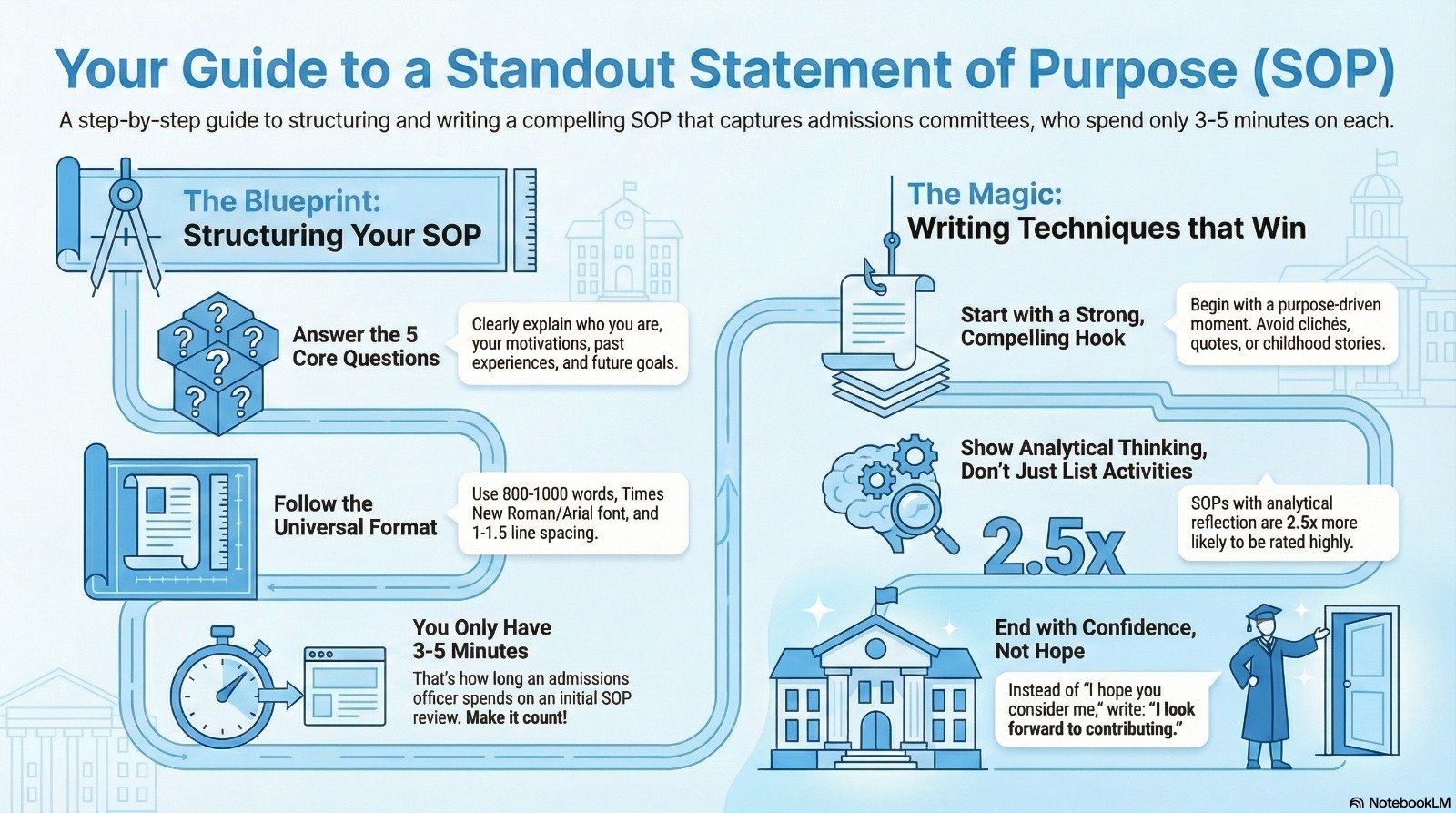
During the initial review, the committee spends only 3-5 minutes on each Statement of Purpose. So, you have to make it perfect; every sentence matters, every word counts!
Generally, a guideline is provided for every Statement of Purpose submission. If none is available, go for the universal format.
Universal format of Statement of Purpose:
- 800-1000 words
- Times New Roman/ Arial font
- 1.0 or 1.5 spacing
- 1-inch margins
- Clear and professional tone
Recommended Structure of Statement of Purpose:
The general structure of the Statement of Purpose should be clear, coherent and well-organized. Your personality should shine; it should be appealing so that the committee decides on the spot that you are the right one.
Your Statement of Purpose should start with an introduction of you, your background, and your motivation. Then, briefly state your academic journey: your courses, skills, and achievements during your academic life. Do not submit a generic statement of purpose. Highlight your program’s unique courses, labs or research centers, faculty members, projects, and internships. Also, mention your professional experiences. Remember, real program knowledge shows commitment, and your commitment will increase your chances of acceptance.
Once you mention your past life, the crucial part begins: Why this program?
In this section, you need to demonstrate that you are the right fit for the program you are applying to, back it up with your career goals, and create a link between them. In the end, reaffirm your commitment. Remember, within each section, your personality should stand out.
Statement of Purpose vs Personal Statement: What Is the Difference?
These two documents are often confused, and submitting the wrong type for a given programme is one of the most avoidable application mistakes. The distinction matters.
Statement of Purpose: Primarily academic and professional. It answers why you want to pursue this specific field at this specific programme, what research or professional experience you have, what you plan to study or research, and what career goals the degree will advance. Tone is formal and analytical. Most common for STEM, social sciences, and research-focused programmes.
Personal Statement: More holistic and narrative. It focuses on your background, personal journey, values, and what you bring to the academic community as a whole person. More common for professional programmes like law, medicine, MBA, and some humanities programmes. Tone is professional but personal.
Some programmes use the terms interchangeably. Always read the prompt carefully. If the programme asks “what do you want to research and why is our programme the right place”, that is an SOP. If it asks “tell us about yourself and what brings you to this field”, it leans toward a personal statement. This guide focuses on the SOP, but many of the techniques apply to both.
Best Writing Techniques for Statement of Purpose
Well, a Statement of purpose is a narration of your life, but you need to present it with spices and defining moments. Let’s look into some of the best strategies that will help you:
Start With a Strong, Compelling Introduction:
You’ve probably heard that you need a hook to grab the reader’s attention. That’s 100% true! The first 150 words of the Statement of Purpose are the right time to catch the attention of the reader. If you are successful, you have won it.
But NO quotes! NO childhood stories! No cliches!
Start with a defining moment, a purpose-driven moment that will build curiosity and authenticity. Think, think hard about that moment that drove you. That was the right time, and you need to put it into words.
Focus On Analytical Thinking, Not Information:
Your Statement of Purpose should include your activities, but not just activities. You do need a description, but they need a reflection on the activity. You need to show depth, the impact of the activity you undergo.
Example: If you have done a research project on solar energy, stating its achievements is not sufficient. Instead, write like this: ‘The solar energy research project during my graduate program taught me how minor improvements in photovoltaic efficiency create a large impact in developing regions.’
Statements of purpose that demonstrate analytical thinking are 2.5 x more likely to be rated highly!
Long-Term Goals Should Be Connected to The Program:
According to the study, a Statement of purpose that articulates well-defined goals has a 35% higher acceptance rate.
Your goals should be realistic, meaningful, and well-aligned with the program you are applying for.
Confident Ending:
Your Statement of Purpose introduction and the ending should be strong. Most importantly, your conclusion should show confidence, not arrogance.
Most students write, ‘I hope you will consider my application’.
This is a BIG NO!
Instead, end like this: ‘I look forward to contributing to your academic community and expanding my research within your program.’
What Does a Strong Statement of Purpose Actually Contain?
The content requirements vary by programme, but every competitive SOP addresses five things in some form:
- Your specific research interest or professional focus, stated early and precisely
- The academic and professional experience that has prepared you for graduate-level work in this area
- A named reason why this programme, specifically, not just any graduate programme, is the right fit, including faculty, labs, courses, or research centres
- Clear career goals that the degree credibly advances
- A sense of what you would contribute to the programme, not just what you would gain from it
What it does not need to include: your GPA (the transcript covers that), every activity you have ever done (the CV covers that), or a broad statement about the importance of the field. Committees know the field is important. They want to know what you specifically bring to it.
The most common feedback from admissions committees at UCL, LSE, and MIT is that SOPs are “too descriptive and not analytical enough.” Listing what you did is not the same as explaining what it taught you and how it connects to what you want to do next.
10 Statement of Purpose Examples With Expert Commentary
Each example below is an annotated excerpt from a successful SOP. Real identifying details have been changed. The annotation explains the specific technique being used and why it works.
Example 1: MSc Computer Science, University of Edinburgh
The summer I spent debugging a distributed ledger system for a supply chain startup in Dubai taught me more about the limits of theoretical computer science than four semesters of coursework had. The system worked. The latency did not. Understanding why led me to every paper I could find on consistency models in distributed systems, and ultimately to the research question I want to pursue at Edinburgh: under what conditions can partial synchrony assumptions in BFT consensus protocols be relaxed without sacrificing correctness guarantees? My undergraduate thesis at UAEU, supervised by Dr. Khalid Al Mansoori, developed a simulation environment for testing consensus algorithm performance under varied network partition scenarios. The results were published in a conference proceedings paper at ICDCS 2024. That work exposed the gap between what the protocols assume about network behaviour and what production environments actually experience. Edinburgh’s Distributed Systems group, and specifically Professor Lewis’s work on probabilistic verification of consensus properties, addresses exactly that gap.
What works: Opens with a specific professional experience in Dubai, which grounds the motivation in something verifiable and concrete. The research question is stated precisely. The faculty member is named with a specific connection to the applicant’s own work. The existing publication gives the SOP immediate credibility.
Example 2: MA Education Policy, UCL Institute of Education
In 2022, the UAE Ministry of Education published a curriculum review noting that 34% of Year 9 students in public schools were reading two or more grade levels below expectation. I was working as a learning support coordinator at a school in Abu Dhabi at the time, and I can tell you that number felt low. What I observed was not a literacy problem in isolation. It was a structural mismatch between how multilingual students, many of them heritage Arabic speakers learning in English medium instruction, process academic language and how that process is assessed. My work over four years developing differentiated reading programmes for Arabic, Urdu, and Tagalog-dominant learners has convinced me that the issue is not one that individual teachers can solve at the classroom level. It requires policy. The MA Education Policy at UCL is where I want to develop the analytical and research skills to work at that level. Professor Rampton’s work on language education policy in multicultural urban schools directly maps to the context I work in. The programme’s placement module with the UAE Ministry would allow me to test research-informed recommendations against the institutional constraints that make reform genuinely difficult.
What works: The opening statistic is from a real, named source, which immediately demonstrates research depth. The personal professional context is specific and credible. The critique of the existing approach is analytical rather than emotional. The UCL programme is named with a specific faculty member and a specific module. This SOP would stand out in any pile.
Example 3: MSc Finance, University of Manchester (UAE Applicant)
The week the UAE introduced its federal corporate tax in June 2023, I was three months into my role as a junior financial analyst at a corporate advisory firm in Abu Dhabi. The next six weeks were some of the most instructive of my career: watching experienced advisors recalculate client tax positions in real time, identify the gaps in existing financial models, and, in several cases, catch errors that had been sitting undetected in spreadsheets for years. I have a strong foundation in financial accounting from my BSc at Abu Dhabi University, where I graduated with a 3.84 GPA. My current work has developed my applied skills in financial modelling and corporate tax compliance. What it has also made clear is the gap between technical knowledge and theoretical depth. I can work with the models. I am not yet confident about when the models break down. The MSc Finance at Manchester addresses that gap directly through its risk and regulation stream. Professor Dougal’s research on regulatory transitions in emerging financial markets is the most directly relevant work I have found to the question I keep returning to: how do UAE SMEs optimally restructure their capital in the years following a tax regime introduction?
What works: The UAE corporate tax context is specific, current, and shows the student is paying attention to their industry. The self-assessment is honest without being self-deprecating. The research question is highly specific. The faculty connection is grounded in a genuine intellectual alignment, not flattery.
Example 4: PhD Mechanical Engineering, Imperial College London
My MSc thesis at Khalifa University modelled thermal deformation in composite concrete panels used in high-rise construction in hot climates. The supervisor expected the results to confirm existing models. They did not. The deformation at extreme heat exposure, specifically above 55 degrees Celsius sustained over 72 hours, consistently exceeded the upper bound predicted by current building code models by a margin of 11 to 18%. That finding has been bothering me ever since. The buildings being constructed right now in Dubai and Abu Dhabi are designed to current code. If my thesis data generalises, there is a gap between what we are building and what we know about how those buildings will behave over time in a climate that is getting warmer, not cooler. I want to pursue doctoral research that tests whether this gap is systematic across material classes and what the implications are for UAE building regulation. Professor Hartley’s work at Imperial on computational modelling of structural materials in extreme thermal environments is the most technically rigorous approach I have found to the problem I am trying to solve.
What works: Opens with a thesis finding that contradicts expectations, which immediately creates intellectual tension. The stakes are stated in practical terms: real buildings, real climate, real risk. The research question is narrow enough to be a PhD project. The connection to Imperial is grounded in methodology, not prestige.
Example 5: MSc Public Health, Harvard T.H. Chan School of Public Health
Dengue fever killed 40,000 people globally in 2022 according to WHO estimates. In the district where I worked as a public health officer in Pakistan, the official count for that year was eight deaths. I spent a significant part of my tenure understanding the gap between those numbers, and what I found was not a data integrity problem in the simple sense. It was a cascade of incentive misalignments: local reporting structures that discouraged disclosure, diagnostic capacity that made confirmation difficult, and a national surveillance system that was not designed to catch what it was not looking for. The MPH programme at Harvard Chan is where I want to develop the epidemiological and health systems research skills to work on surveillance design at the policy level. The Global Health Systems concentration and the practicum with the WHO EMRO office align directly with my professional focus on infectious disease surveillance in low-to-middle income health systems.
What works: The opening statistics are from a named, verifiable source. The personal professional detail is specific and immediately raises a question the essay then answers. The critique of the surveillance system is analytical and precise, not emotional. The programme connection is specific about the concentration and the practicum opportunity.
Example 6: MBA, London Business School
I have built and exited one business and watched a second one fail. The first, a logistics technology startup I co-founded in 2018, scaled to 12 full-time employees and was acquired by a regional e-commerce group in 2021. The second, a platform for matching freelance engineers with short-term project contracts, ran out of runway in 2022 after 14 months. Both experiences taught me things I could not have learned from either a textbook or a mentor alone, but they also showed me the edge of what I can figure out without formal training in strategy, finance, and organisational behaviour. The specific gap I want to close is in corporate finance and strategic decision-making under uncertainty. My intuition has served me reasonably well. My analytical framework has not always kept up with it. The MBA at LBS is the programme I have identified as the best place to close that gap, partly because of the curriculum structure, partly because of the cohort profile, and partly because of access to the fintech and venture communities in London, which is where I intend to build next.
What works: Leads with a concrete professional record that most MBA applicants cannot match. The failure is acknowledged without drama or excessive reflection. The gap identified is analytical and specific. The connection to LBS is honest and multidimensional, covering curriculum, cohort, and geography.
Example 7: MSc Clinical Psychology, King’s College London
I have been a volunteer crisis counsellor for three years, mostly working overnight shifts on a text-based support line. The experience has shaped how I think about therapeutic contact in ways that clinical placements in a formal setting probably would not have. On a text line, there is no body language, no tone of voice, no visual cues. There is only what the person has chosen to type and what you choose to type back. Every word is a decision. That constraint made me a more careful listener and a more precise communicator. It also raised a research question I have not been able to let go of: how does the medium of therapeutic communication affect the therapeutic alliance, and what does that mean for the rapidly growing field of digital mental health interventions? The MSc Clinical Psychology at King’s gives me the research training and supervised clinical practice hours I need to pursue this question rigorously. Dr. Iyadurai’s work on intrusive imagery and cognitive interference mechanisms in PTSD is in an adjacent space to the therapeutic medium research I want to pursue, and I would welcome the opportunity to develop those adjacent methodological tools.
What works: The opening is a specific professional context that most applicants for clinical psychology will not have. The reflection on what the experience taught is analytical rather than sentimental. The research question emerges organically from the experience. The faculty connection is intellectually honest: adjacent rather than identical, which is more credible than claiming perfect alignment.
Example 8: MA Sociology, Columbia University
The research I care most about sits at the intersection of urban informality and digital infrastructure. Specifically: how do informal settlement residents in the Gulf region, many of them labour migrants without formal address registration, navigate the increasingly address-dependent architecture of digital service access? This matters because most digital financial services, healthcare portals, and government benefit systems require an address as the foundation of identity verification. If you do not have one in the system, you effectively do not exist to those systems. My undergraduate thesis at Sharjah University examined how informal settlement residents in Ajman used social networks as a substitute for formal institutional access. That work is the empirical foundation for the question I want to pursue at Columbia. Professor Sassen’s theoretical framework on global cities and the urban informal economy is the lens I want to apply to it.
What works: Leads with a specific research question rather than personal background, which works for a PhD-track MA application. The UAE context is highly specific and original. The research gap is clearly articulated. The connection to a named Columbia faculty member and a specific theoretical framework is exactly what a research-focused admissions committee needs to see.
Example 9: MSc Data Science, University of Toronto
For two years I worked as a data analyst at a mid-sized healthcare provider in Dubai. My job was, formally, to produce dashboard reports on operational efficiency metrics. What it actually became was trying to figure out why the hospital’s patient readmission rate for cardiac patients had been climbing by roughly 3 to 4% annually for three years despite consistent improvements in every metric we were tracking. The short answer, which took most of a year to find, was that we were tracking the wrong metrics. The readmission rate was correlated with discharge planning quality, which we were not measuring. That experience is why I want to study machine learning approaches to healthcare outcome prediction, and specifically why I am interested in the interpretability problem: building models that clinicians can actually use to change decisions rather than models that are accurate in aggregate but opaque in application. The MSc Data Science at Toronto, and specifically the Healthcare Analytics concentration, is where I want to develop the technical depth to work on this problem at a research level.
What works: The career experience is specific and reveals analytical thinking through the narrative of solving a real problem. The research question emerges from the experience rather than being imposed on it. The programme connection is specific and credible.
Example 10: MSc Environmental Engineering, Delft University of Technology
The Liwa oasis in Abu Dhabi has the largest continuous sand dune system in the world. It also has a water table that has been dropping at a measured rate of approximately 0.6 metres per year for the past decade according to ADWEA monitoring data. The two facts are not unrelated. Understanding why and modelling what happens next under different groundwater management scenarios is the research I want to do. My BSc in Civil Engineering from UAEU included a final year project on groundwater recharge rates in arid environments, co-supervised by the UAE Environment Agency. That project used MODFLOW to model a small pilot zone and produced data that contributed to a preliminary agency report. I know how to work in this space at the entry level. I want to work in it at the level where the modelling assumptions themselves are what is being designed. Delft’s research group on arid zone hydrology, and specifically the work being done on integrated surface water and groundwater modelling in the Arabian Peninsula, is the most technically advanced work I know of in this specific area.
What works: Leads with a striking, verifiable fact about the UAE’s physical environment. The research question is specific, geographically grounded, and has clear policy implications. The existing work is described with enough detail to be credible. The programme connection is specific and technically precise.
Writing Techniques That Make the Difference
Start with the moment, not the background
The opening paragraph is the most important one and the most commonly wasted. Most SOPs open with broad statements about the importance of the field or the applicant’s long-standing passion. The SOPs that catch attention open with a specific, concrete moment: a finding that did not match expectations, a professional problem that led to a question, a specific data point that changed the direction of the applicant’s thinking.
If your current draft opens with “Since childhood, I have been fascinated by…”, or a quote from a famous scientist, or a sweeping statement about global challenges, cut it. Find the most specific moment in the document and move it to paragraph one.
Connect experience to direction, not just list it
Every experience mentioned in your SOP needs to do two things: demonstrate relevant capability and explain how it shapes your current research direction. “I completed an internship at XYZ Company” does nothing. “My internship at XYZ Company is where I first encountered the data quality problem that I want to address at the research level” is doing real work in the document.
Be specific about the programme
The weakest part of most SOPs is the section about why the programme. “Your world-class faculty and excellent research facilities” could apply to any graduate institution. Name one faculty member whose work you have read and explain why it connects to yours. Name one course or research centre. If you cannot do this, you have not researched the programme enough to write a convincing SOP for it.
The closing should be confident, not grateful
Endings like “I hope you will consider my application” signal uncertainty. The committee is reading hundreds of SOPs from qualified candidates. Your closing should reflect that you are one of them. “I look forward to contributing to your department’s research on X and pursuing the questions I have outlined above” is a confident, forward-facing close that leaves the right impression.
Using AI Tools to Write a Better SOP (Without Producing a Generic One)
AI tools like Claude and ChatGPT can genuinely help with SOP writing, but almost every student who has tried them has discovered the same problem: the output is grammatically clean, reasonably structured, and sounds exactly like thousands of other SOPs produced by people using the same tools.
The reason is straightforward. If you ask an AI to “write an SOP for a computer science master’s programme”, it generates a plausible-sounding document based on patterns from thousands of other SOPs. The result has no specific experiences, no real research question, no genuine faculty connection, and no individual voice. An admissions committee that has read a few hundred AI-assisted SOPs will recognise it within the first paragraph.
The way to use AI effectively for an SOP is to use it as a tool for specific tasks rather than as a ghostwriter for the whole document. Here are the approaches that actually work.
Prompt 1: Extract your strongest opening from your raw material
I am writing a statement of purpose for [programme name] at [university name]. Here is the experience I want to open with: [describe the specific moment, finding, or professional situation in 3-5 sentences]. Generate 5 different opening paragraphs based on this material, each using a different technique: specific scene, surprising data point, research question, professional problem, and counterintuitive observation. Keep each under 80 words. Do not add experiences I have not mentioned.
This prompt works because you are giving the AI your raw material rather than asking it to invent material. The specificity comes from you. The craft comes from the AI generating options for you to choose from and refine.
Prompt 2: Test whether your faculty connection is convincing
Here is the paragraph from my SOP where I explain why [university] is the right programme for my research interests: [paste paragraph]. Act as an admissions committee member who has read 300 SOPs this season. Is this connection specific enough to be convincing, or does it read like the applicant googled the programme for five minutes? What one change would make it more credible? Be direct.
The “act as” framing is important. Without it, most AI tools will offer gentle suggestions. Giving it a specific critical role produces more honest and useful feedback.
Prompt 3: Close the gap between description and analysis
Read this paragraph from my SOP: [paste paragraph]. Tell me: am I describing what I did, or am I analysing what I learned and how it connects to my research direction? If I am mostly describing, rewrite the paragraph to be analytical rather than descriptive. Keep all the factual details. Change how they are presented. Ask me for any missing information before rewriting.
This is the single most useful AI intervention for SOPs that are technically accurate but too descriptive. The instruction to ask for missing information before rewriting prevents the AI from inventing details.
One important caution
Whatever AI produces, read it out loud. If it does not sound like you, if the vocabulary is more formal than you would naturally use, if the sentence structures feel constructed rather than natural, revise it until it does. Admissions committees are reading for a person. If the document sounds like a language model’s version of a strong graduate applicant rather than an actual human being, it will be noticed.
EssaySouq’s free AI Humanizer tool can help you identify and remove AI writing patterns from your draft before submission.
Statement of Purpose Advice for UAE Students Applying Abroad
UAE students applying to graduate programmes in the UK, US, Canada, or Europe have specific context that, if used well, is a genuine asset in an SOP. The UAE’s economic and policy environment is distinctive, current, and directly relevant to several high-demand fields including finance, engineering, urban planning, public policy, and environmental science.
The corporate tax introduction in 2023, the clean energy transition goals in Abu Dhabi’s ADNOC and Masdar programmes, the UAE Vision 2031 education reform, the significant infrastructure and smart city development pipeline, the multilingual education environment, and the scale of the UAE’s migrant labour population are all substantive, real contexts that can anchor a highly specific research question in a way that stands out from applicants from other regions.
What does not work is mentioning the UAE as a general background detail without connecting it to a specific research question or professional experience. “Growing up in a diverse, multicultural society like the UAE taught me the value of different perspectives” is a sentence that could appear in any SOP and is doing no analytical work.
What does work is what you see in examples 1, 2, 3, 4, and 10 above: a specific UAE context that grounds a specific research question that only this applicant, from this professional or academic background, in this place and time, would be asking.
EssaySouq supports students at UAEU, Abu Dhabi University, Zayed University, Khalifa University, Higher College of Technology, and Al Ain University in developing strong SOPs for international graduate applications. Our writing tutors work one-to-one and are available around the clock.
The SOP Mistakes Admissions Committees See Most Often
Opening with a quote: So overused that multiple university admissions guides now specifically list it as something to avoid. If a quick Google search produces the quote you are planning to use, do not use it.
Summarising the CV in paragraph form: Your application package already contains your CV. The SOP’s job is not to re-describe your credentials. It is to explain what those credentials mean and where they are pointing.
Generic programme praise: “Your programme’s excellent reputation and world-class faculty” is not a reason to attend a specific programme. Name something specific.
Vague research interests: “I am interested in machine learning and its applications in healthcare” is not a research interest. It is a field. A research interest sounds like: “I want to study whether interpretability-focused ML architectures produce measurably better clinical decision uptake than black-box models in secondary care triage settings.”
Passive or apologetic tone: Every sentence in an SOP should project forward momentum. Phrases like “I hope to learn”, “I would be grateful for the opportunity”, and “I feel I could potentially contribute” communicate low confidence. Active, direct, first-person construction signals readiness.
Ready to Write Your Statement of Purpose?
A strong SOP is rarely written in a single draft. It takes multiple passes, honest outside feedback, and a clear understanding of what the specific programme is looking for. The examples and techniques in this guide give you the framework. The execution takes time and iteration.
Use EssaySouq’s free AI Thesis Statement Generator to sharpen your research focus before you write.
Check your draft’s structure with the free Essay Outline Generator.