

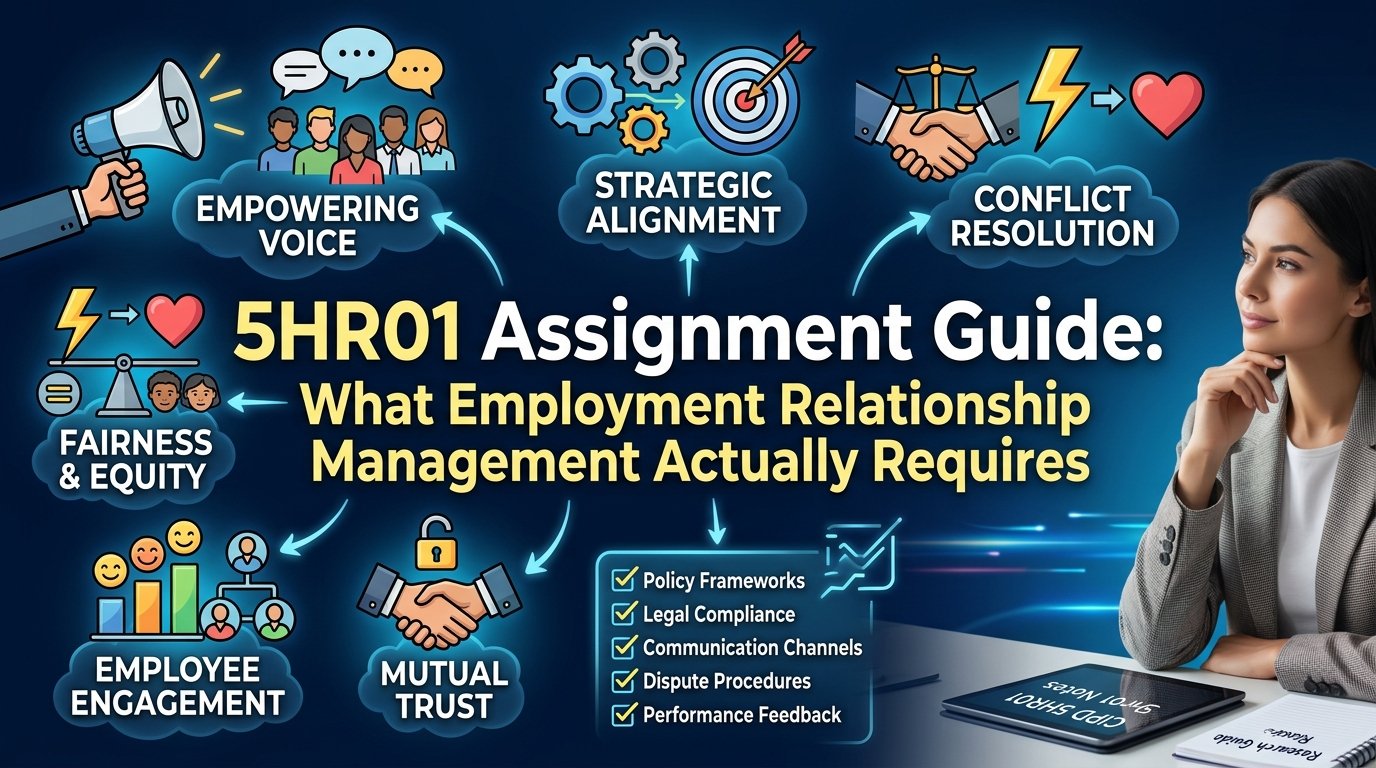
5HR01 is, by a wide margin, the unit we see the most assignment requests for. Ask most CIPD Level 5 cohorts which unit gave them the most trouble and 5HR01 comes up constantly, not because the content is obscure, but because the assignment brief looks deceptively straightforward until you sit down and try to write a distinction-level answer.
The problem is rarely a lack of knowledge. Most students studying 5HR01 already work in HR or a related field and could talk through employee voice or conflict resolution in a meeting without any preparation. The problem is translating that working knowledge into the specific evidence structure the assessment criteria demand. This guide goes through what each AC in 5HR01 is actually checking for, where students consistently lose marks, and how to handle the UK employment law content when you are studying and working in the UAE.
Quick note before we start: This guide covers what markers are looking for so you can write a stronger assignment yourself. If you would rather have an expert write it for you, our CIPD team covers 5HR01 and every other CIPD unit directly.
What 5HR01 Actually Covers
Employment Relationship Management sits in the specialist knowledge modules of CIPD Level 5. It is built around four broad areas: the nature of the employment relationship itself, employee voice, engagement and involvement, and conflict resolution. On paper that sounds like four separate topics. In practice, the strongest answers treat them as connected: how the employment relationship is framed determines how voice and engagement operate, and how well voice and engagement operate determines how much conflict shows up later.
The unit specifically expects you to draw on UK employment law and CIPD professional standards, even if you are studying and working in the UAE or wider GCC. This catches a lot of students out. CIPD is a UK-regulated professional body, and 5HR01 assessment criteria are written against UK legislation such as the Employment Rights Act 1996 and the Equality Act 2010. Applying UAE labour law instead of the UK framework the unit specifies is one of the most common reasons an otherwise well-written answer loses marks. We will come back to how to handle this properly further down.
The Assessment Criteria, and What Each One Is Actually Checking For
This is the part most study guides skip. Below is every AC in 5HR01 with a plain explanation of what it is asking, and what markers are specifically looking for as evidence of a distinction-level answer rather than a pass-level one.
| AC | What it asks | What the marker is checking for |
| AC1.1 | Explain the nature of the employment relationship | Distinguish clearly between the legal contract of employment and the psychological contract. A common failure is describing only one and calling it complete. |
| AC1.2 | Explain how the psychological contract differs from the employment contract | Give specific examples of implicit expectations (trust, fairness, development opportunities) versus the explicit terms in a written contract. |
| AC2.1 | Assess the role of the main emerging trends in employee voice | Differentiate formal mechanisms (works councils, union representation, staff surveys) from informal ones (open-door policies, team meetings). Markers want named mechanisms, not a general statement that voice matters. |
| AC2.2 | Explain the concept of better working lives and how this can be designed | Link explicitly to flexible working, work-life balance policy, and employee wellbeing initiatives, grounded in a specific organisational example. |
| AC2.3 | Explain the principles of engagement and the ways that people practice can support engagement | Reference an engagement model (such as the Macleod and Clarke enablers) rather than describing engagement in generic terms. |
| AC3.1 | Explore the concepts of employee engagement, involvement and participation, and how these can be applied practically | Show the distinction between engagement (emotional connection), involvement (contribution to decisions), and participation (formal representation). |
| AC3.2 | Identify the various forms of conflict behaviour and dispute resolution | Cover both formal routes (grievance and disciplinary procedures, ACAS-equivalent conciliation) and informal ones (mediation, negotiation). |
| AC3.3 | Assess the emerging trends in the types of conflict and industrial sanctions | Demonstrate awareness of current trends: reduced strike action in some sectors, rise of individual employment tribunal claims, growth of informal dispute resolution. |
Look closely at the pattern across all eight criteria. Almost none of them are asking you to define a concept. They are asking you to distinguish between two related things (contract versus psychological contract, engagement versus involvement versus participation), or to apply a named model to a specific scenario. A definition-only answer, however accurate, will not reach the marks available for analysis and application.
Where Students Actually Lose Marks
Having reviewed a large number of 5HR01 drafts, the mark-losing patterns repeat with striking consistency.
1. Treating the psychological contract as an afterthought
AC1.2 specifically asks for the difference between the legal employment contract and the psychological contract. Students often define the psychological contract accurately but never explicitly contrast it with the legal contract in the same paragraph. Markers are checking for the distinction, not just the definition.
2. Listing voice mechanisms instead of evaluating them
AC2.1 wants an assessment of emerging trends in employee voice, not a list. Naming four voice mechanisms and moving on describes; a distinction answer explains why certain mechanisms are becoming more or less prominent and what that means for HR practice.
3. Applying UAE labour law where UK law is specified
This is worth its own section given how often it happens, and we cover exactly how to handle it below.
4. Describing conflict types without connecting them to resolution mechanisms
AC3.2 and AC3.3 work together. Describing formal and informal conflict without linking each type to the appropriate resolution route (grievance procedure, mediation, ACAS-equivalent conciliation) leaves half the analysis undone.
5. Generic engagement content with no organisational example
AC2.3 and AC3.1 both reward application to a specific organisation, real or hypothetical, over generic statements about why engagement matters. Pick one organisation and use it consistently across both criteria rather than switching examples paragraph to paragraph.
How to Handle UK Employment Law While Studying in the UAE
This deserves direct attention because it is the single most common structural mistake we see, and it is an easy one to avoid once you understand why it happens.
CIPD is a UK-headquartered professional body, and its Level 5 qualification, including 5HR01, is built around UK employment law: the Employment Rights Act 1996, the Equality Act 2010, and related legislation on unfair dismissal, discrimination, and collective consultation. When you are working and studying in the UAE, it is instinctive to reach for UAE Labour Law (Federal Decree-Law No. 33 of 2021) as your reference point, because that is the law that actually governs your workplace. Doing this in a 5HR01 assignment, however, usually costs marks, because the assessment criteria are written against a specific legal framework that your marker is checking for.
The better approach is to reference UK legislation as the primary legal framework the unit requires, while noting where relevant that UAE practice differs. This shows both that you understand the UK framework the qualification is built on, and that you can apply comparative judgement, which is itself a mark-worthy skill at Level 5. For example, when discussing unfair dismissal protections under AC1.1 or AC1.2, you might explain the UK position under the Employment Rights Act, then briefly note that UAE Labour Law approaches termination and notice periods differently, without letting that comparison become the main content of your answer.
A Practical Structure for a Strong 5HR01 Answer
A well-structured answer for 5HR01 typically follows the order of the assessment criteria, since most cohort briefs are organised this way, but with genuine analytical connective tissue between sections rather than eight disconnected mini-essays.
- Open with a short introduction framing the employment relationship as the thread connecting all three sections of the unit, not just a definitions paragraph.
- Address AC1.1 and AC1.2 together, since they are naturally linked: define the legal contract, then explicitly contrast it with the psychological contract.
- Move through AC2.1 to AC2.3 as a connected discussion of voice and engagement, using one consistent organisational example throughout.
- Cover AC3.1 to AC3.3 as the conflict section, explicitly linking each conflict type back to a specific resolution mechanism.
- Close with a short conclusion that ties the three sections back to the opening framing, rather than simply repeating what was already said.
Need Help With Your 5HR01 Assignment?
Our CIPD team covers 5HR01 and every other Level 3, 5, and 7 unit, with writers who hold CIPD qualifications themselves and know exactly what each AC is checking for. Every completed assignment includes a Turnitin originality report.